
Every client who comes to me with a stagnant rankings problem makes the same mistake: they fix on-page content without touching the signals that come from outside their website. That’s where this off-page SEO checklist comes in. Off-page SEO covers everything Google measures beyond your own pages — backlinks, local citations, brand mentions, and authority signals that determine how much your site is trusted compared to competitors.
This checklist breaks everything into four sections: link building, local citations, brand signals, and content distribution. Work through it monthly and you’ll cover the main levers that move rankings without touching a single line of code on your site.
Table of Contents
Why Off-Page SEO Still Moves Rankings
In my client audits, sites stuck on page two almost always have decent on-page SEO but weak off-page authority. Google’s ranking system still uses links as a primary trust signal — a page that earns genuine links from relevant sites ranks higher than a technically perfect page with none. Before running this checklist, make sure your technical SEO audit is complete and your site is crawlable. Off-page work amplifies a solid on-page foundation.
According to Google’s documentation on links, both the number and quality of links pointing to a page factor into how it ranks. That’s been true for two decades and remains the case today, even as Google adds additional signals.
Link Building Checklist
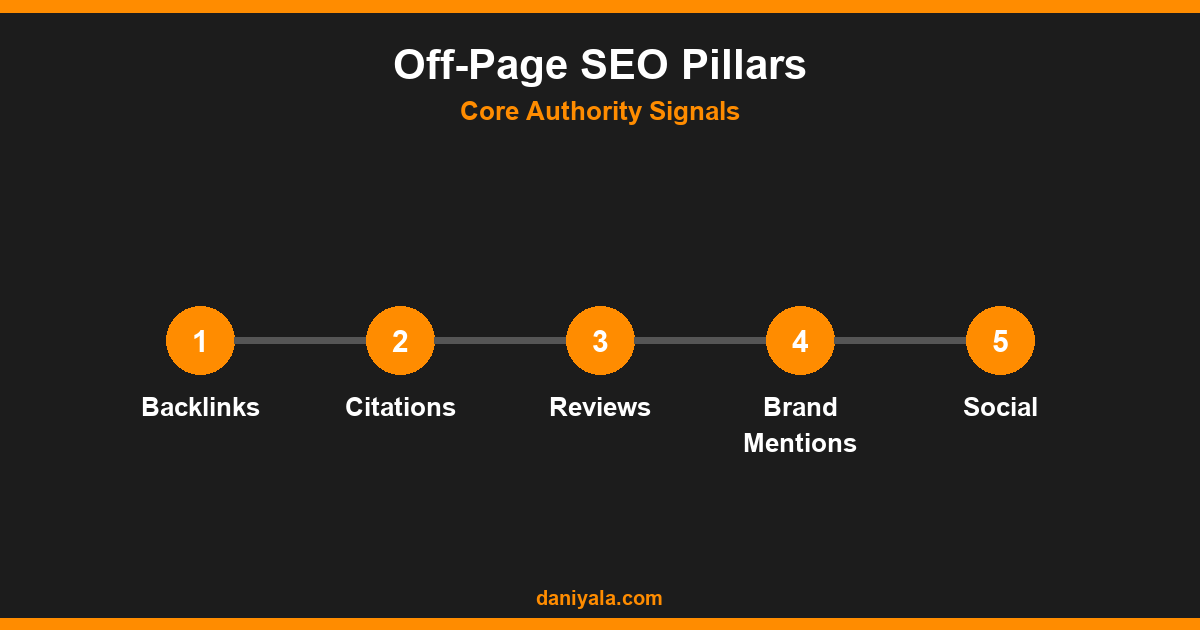
This is the core of off-page SEO. Not all links are equal — a single link from a relevant, high-authority site can move rankings more than 50 links from low-quality directories.
- Audit your existing backlinks. Use Google Search Console or Ahrefs to see which domains are linking to you. The Links report in GSC shows referring domains for free.
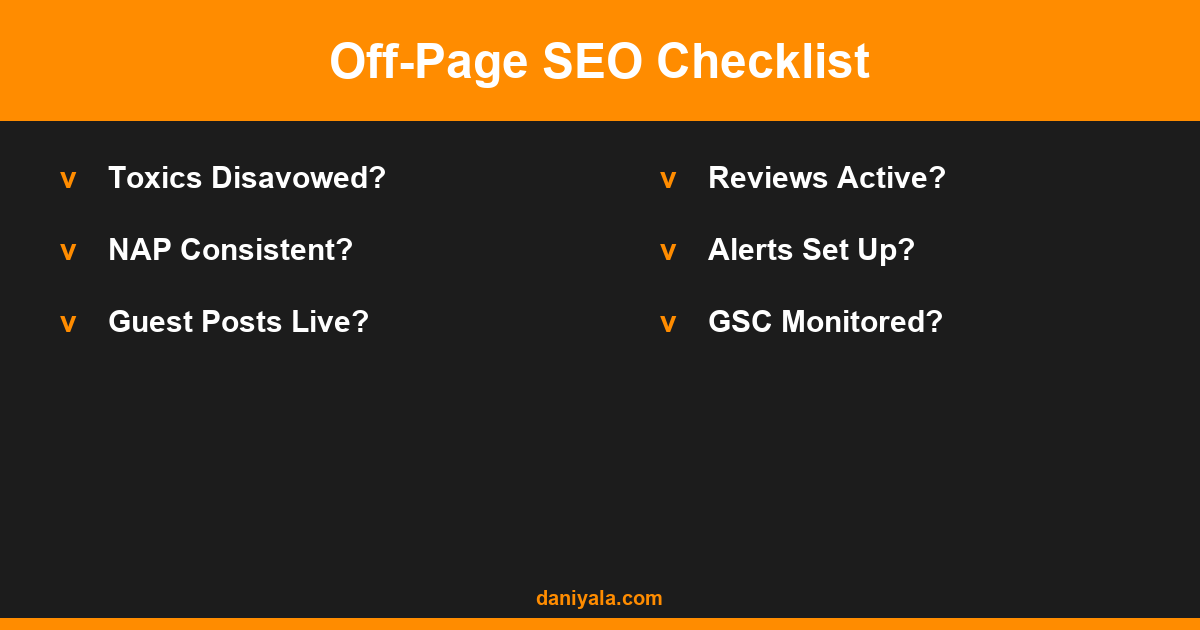
- Disavow toxic links. If you have spammy backlinks from link farms or irrelevant foreign directories, upload a disavow file via Search Console. Do this carefully — only disavow links you’re confident are harmful.
- Identify competitor link sources. Export your top three competitors’ backlink profiles and find which sites link to all of them. Those are your priority outreach targets.
- Write guest posts for relevant sites. Guest posting on sites your target audience reads is one of the few reliable ways to earn editorial links. Pitch specific topic angles, not just a generic “I want to guest post” request.
- Claim unlinked brand mentions. Search for your business name in quotes. If you find articles mentioning you without a link, email the author and ask them to add one. Most will oblige.
- Build resource page links. Search for “useful resources” or “recommended reading” pages in your niche and pitch your best content for inclusion.
- Earn links through original data. Case studies, surveys, and original research attract links naturally. Write up aggregated client experiences and pitch the findings to industry publications.
- Fix broken backlinks. Find pages that used to link to you but now return 404 errors. Either redirect the old URL or contact the linking site to update the link.
Local Citation Checklist
For businesses serving a geographic area, local citations — mentions of your name, address, and phone number (NAP) — are a direct local ranking factor. Inconsistent NAP data across directories is one of the most common local SEO problems I fix for clients.
- Claim your Google Business Profile. This is non-negotiable. A fully verified and optimised GBP listing is the most powerful local citation you have.
- Audit your NAP consistency. Check Yelp, Facebook, Yellow Pages, and any industry directories. Your business name, address, and phone number must match exactly — abbreviations and formatting variations confuse Google.
- Submit to core directories. Bing Places, Apple Maps, Yelp, Foursquare, and Facebook are the essential ones. Most accept free listings.
- Find niche-specific directories. A WordPress developer should be on Clutch.co and DesignRush. A law firm needs Avvo and FindLaw. Relevant industry directories carry more weight than generic ones.
- Remove duplicate listings. Multiple listings for the same business on the same directory dilute authority and confuse customers. Merge or delete duplicates where possible.
- Add photos and descriptions everywhere. Directories that allow photos and business descriptions rank better in their own search results, giving you visibility beyond Google.
Brand Signal Checklist
Google measures how often your brand is searched and mentioned as a proxy for real-world authority. A brand people actively seek out is a brand worth ranking. These are the signals you can influence directly.
- Set up Google Alerts for your brand name. Monitor every mention of your business across the web. Respond to reviews, comment on forum mentions, and track where your name appears.
- Earn reviews on Google, Trustpilot, and Clutch. After completing a project, send a direct review link to your client. Most satisfied clients will leave a review if you make it a single click. Quantity and recency both matter.
- Get interviewed or quoted in industry content. HARO and similar services let you respond to journalist queries and earn mentions in media. One mention in a relevant publication does more for brand signals than 20 directory listings.
- Keep social profiles active. Pick two platforms your audience uses and post consistently — even once a week beats sporadic posting.
- Encourage branded searches. Email newsletters, offline business cards, and internal linking strategies that bring people back to your homepage all contribute to branded search volume.
Content Distribution Checklist
Great content that nobody sees does not earn links. Distribution is how you get your content in front of people who might link to it, share it, or cite it.
- Share new articles via email list. Even a small email list sends real traffic on day one, which signals to Google that your content is relevant.
- Post to relevant LinkedIn groups and subreddits. Add context and start a conversation. Pure link drops get removed.
- Repurpose content as LinkedIn articles. Summarise your key points on LinkedIn with a link back to the full article. LinkedIn posts reach a professional audience who may link to your content from their own sites.
- Submit to niche content aggregators. Industry newsletters, Feedly collections, and topic-specific communities distribute content to audiences already interested in your subject.
- Pitch content to journalists covering your topic. A well-written how-to guide that fills a gap journalists keep needing to explain will earn links over time as they reference it repeatedly.
- Update and redistribute old content. Refreshing a year-old guide and re-promoting it as an updated version drives new links to existing pages without creating new URLs.
Monitoring Your Off-Page SEO Progress
You cannot improve what you do not measure. Track these metrics monthly alongside your on-page SEO checklist and technical SEO checklist.
- Total referring domains — not total backlinks. One high-quality site linking 10 times is worth less than 10 different sites linking once each.
- Domain Rating or Domain Authority — track month-over-month movement as a proxy for overall link authority.
- New vs. lost backlinks — you want new links consistently outpacing lost ones. Losing links from offline sites is normal; losing links from live sites needs investigation.
- Branded search volume — visible in Google Search Console under Queries. Filter for your exact business name and track impressions month over month.
- Review count and average rating — across Google and any platform your clients use. Target at least two new reviews per month.
If you also want to improve your technical SEO in parallel, prioritise Core Web Vitals first — a fast, stable site gets more benefit from every link you earn.
Frequently Asked Questions
What is off-page SEO?
Off-page SEO refers to all optimisation activities that happen outside your own website — primarily link building, local citations, and brand signal development. It contrasts with on-page SEO (title tags, content, internal linking) and technical SEO (site speed, crawlability, schema). All three work together; off-page SEO amplifies the value of good on-page and technical foundations.
How many backlinks do I need to rank?
There is no universal number. What matters is having more relevant, authoritative links than your direct competitors for the keyword you’re targeting. In low-competition niches, 5–10 quality links can be enough. In competitive markets, you may need dozens of strong referring domains. Focus on quality and relevance over raw quantity.
How long does off-page SEO take to show results?
Link building typically takes 3–6 months to show measurable ranking movement. Google needs to crawl and index the linking page, pass the link equity, and reassess your page’s authority. Local citations can improve local pack rankings faster — sometimes within 4–8 weeks of fixing NAP consistency across major directories.
Is off-page SEO the same as link building?
Link building is the largest component of off-page SEO but not the only one. Off-page SEO also includes local citation management, brand signal development (reviews, branded search volume), content distribution, and social presence. For local businesses, citation consistency can be as important as backlinks for local pack rankings.
Can I do off-page SEO myself?
Yes, most of it. Guest posting, broken link outreach, claiming brand mentions, and submitting to directories are all tasks you can handle yourself with time. Freelancers typically help most with scaling outreach and identifying link opportunities using specialist tools like Ahrefs or Semrush.
Need help implementing this? I’m Daniyal — freelance SEO & WordPress expert. Contact me or find me on Upwork.







 by Daniyal © 2026 All Rights Reserved