
Most small business owners come to me after two experiences: either they tried to do their own SEO for six months with no results, or they paid an agency and got a monthly report full of graphs that never translated into actual enquiries. Understanding what seo services for small business actually include — and what they should cost — is the first step to avoiding both traps.
I’ve been working with small businesses on SEO for several years now, handling everything from site audits to ongoing content and link-building campaigns. Here is what I have learned about what genuinely works, what is padding, and how to tell the difference before you sign a contract.
Table of Contents
- What SEO Services for Small Business Actually Include
- Monthly Retainer vs. Project-Based SEO
- Realistic Results: What a Small Business Can Expect from SEO
- How to Evaluate an SEO Agency or Freelancer
- Red Flags When Hiring SEO Services
- Local SEO Services vs. Broader SEO Campaigns
- What SEO Services for Small Business Typically Cost
- Should You Hire an Agency, Freelancer, or DIY?
- Frequently Asked Questions
What SEO Services for Small Business Actually Include
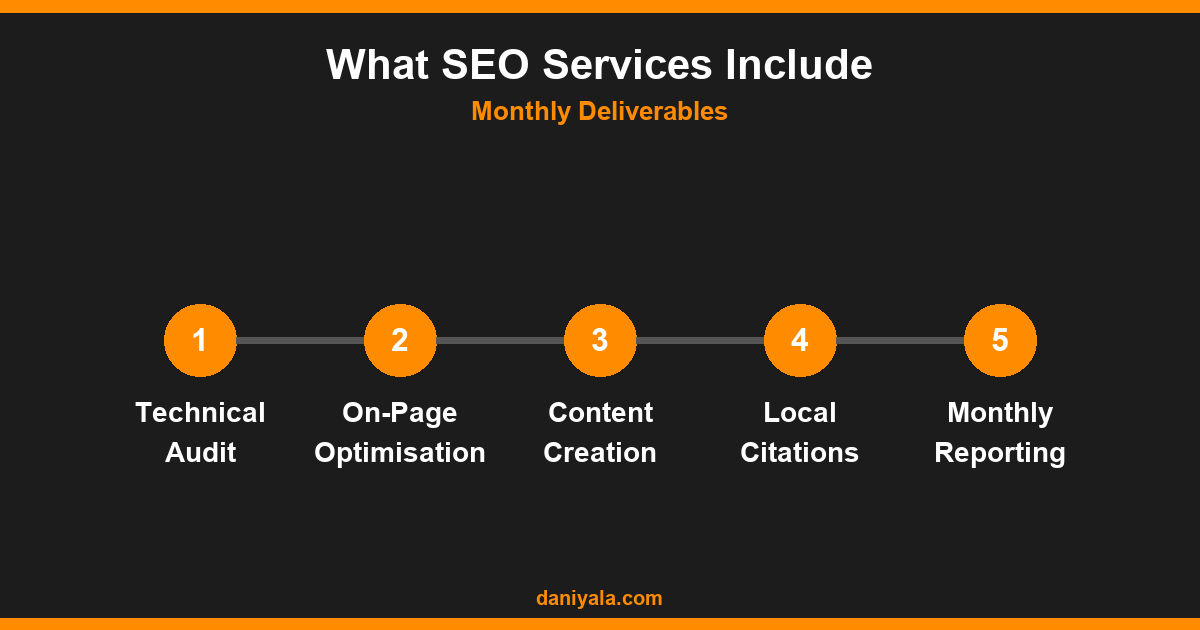
Legitimate SEO services for small business should cover a specific, documented set of deliverables — not vague promises about “improving your online presence.” Here is what a reasonable monthly retainer typically includes:
- Technical audit and ongoing monitoring: Checking for crawl errors, broken links, slow pages, indexing issues, and Core Web Vitals problems. This is the foundation — without a technically healthy site, nothing else works well.
- On-page optimisation: Improving title tags, meta descriptions, heading structure, and internal linking on existing pages. Often the fastest way to move rankings on a site that already has some Google visibility.
- Keyword research and content strategy: Identifying which terms your customers actually search for and building a content plan around them. This is where long-term organic traffic comes from.
- Content creation: Writing optimised blog posts, service pages, or landing pages that target specific keywords. Quality matters enormously here — thin content ranks for nothing.
- Local SEO management: Google Business Profile optimisation, citation building, and review strategy for businesses serving a geographic area.
- Monthly reporting: A clear report showing keyword rankings, organic traffic trends, and what was done that month — with context, not just raw numbers.
If a provider cannot tell you clearly which of these they deliver each month, that is a warning sign worth taking seriously.
Monthly Retainer vs. Project-Based SEO
There are two main ways to buy SEO services, and which one suits your business depends on where you are right now.
Monthly retainer: You pay a fixed amount each month for ongoing SEO work — typically covering some combination of the deliverables listed above. This makes sense when you want continuous momentum: fresh content, regular technical monitoring, and someone accountable for tracking results over time. Most businesses that want SEO to become a reliable lead source eventually end up on a retainer model.
Project-based SEO: A one-time engagement for a specific deliverable — a full technical audit, a site migration, a local SEO setup, or a set number of optimised pages. This suits businesses that want to fix a specific problem rather than ongoing management. A project engagement often makes sense as a starting point before committing to monthly retainers: you get a clear picture of what needs fixing, and you can decide how much of the implementation to handle yourself.
For a breakdown of what both models typically cost, see my SEO pricing guide — it covers real-world ranges for different business sizes and markets.
Realistic Results: What a Small Business Can Expect from SEO
I always tell clients the same thing: SEO is not a switch you flip. It is a compounding investment that builds over time. Here is a realistic timeline for a typical small business starting from a relatively clean site with some existing traffic:
- Months 1–2: Technical fixes, on-page optimisation, GBP setup. You may see small improvements in impressions in GSC. No significant traffic change yet.
- Months 3–4: New content starts getting indexed. Rankings for lower-competition keywords begin to move. Local pack positions may improve if GBP work is done well.
- Months 5–6: Organic traffic shows a clear upward trend. Some pages may reach page one for targeted keywords. Enquiries from organic search become traceable.
- Months 7–12: SEO becomes a reliable, measurable lead source. Authority builds, making new content rank faster. The compounding effect becomes visible in GSC data.
Businesses in very competitive markets (lawyers, real estate, insurance) take longer. Businesses targeting specific local areas or niche industries often move faster. The timeline also accelerates significantly if the site already has domain authority from previous work.
How to Evaluate an SEO Agency or Freelancer
Before hiring anyone for SEO services, ask these questions and pay close attention to how they answer:
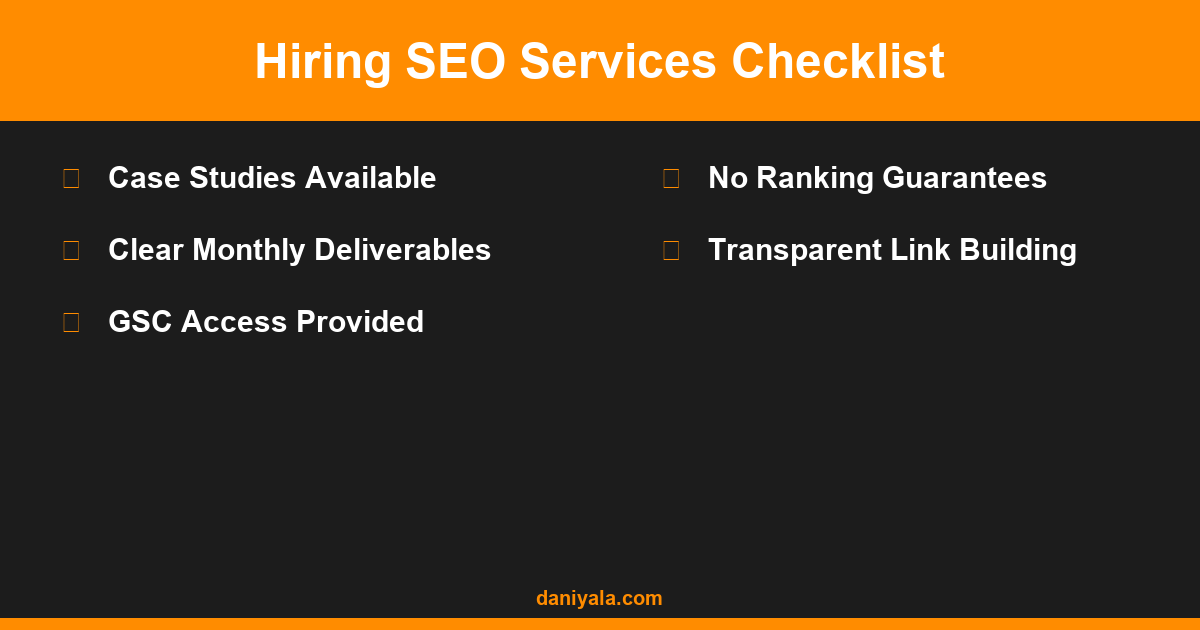
- “Can you show me case studies of small business clients in a similar niche or location?” Specific examples with real outcomes — not generic testimonials — are the best evidence of competence.
- “What will the monthly deliverables be, exactly?” A good provider gives you a documented list, not a vague scope. You should know what you are getting before you pay.
- “How do you measure success and report on it?” Keyword rankings, organic traffic growth, and leads from organic are the right metrics. Pure “impressions” growth with no click data is a vanity metric.
- “What happens in months one and two?” Legitimate providers spend the early period auditing and fixing fundamentals. Anyone promising dramatic rankings within 30 days is either lying or using techniques that will hurt you later.
- “Do you outsource any of the work?” Not inherently a problem — but you should know whether the person you are talking to is actually doing the work or managing a team (and what that team’s quality level is).
If a provider is evasive about any of these, that tells you something important. Good SEO practitioners are not secretive about their process because there is no magic in it — just disciplined execution of well-understood techniques.
Red Flags When Hiring SEO Services
These are the patterns that consistently appear before a small business owner comes to me to fix what a previous provider broke:
- Guaranteed first-position rankings: No one can guarantee Google rankings. Anyone who promises a specific rank is either lying or will use techniques (keyword stuffing, link schemes) that create short-term gains and long-term penalties.
- No transparency about link building: If they cannot tell you exactly where they are building links and what those sites look like, assume the worst. Low-quality link schemes are the fastest way to trigger a Google penalty.
- “Secret methods” or proprietary systems: Good SEO is based on well-documented best practices from Google’s own documentation. There are no secret techniques — anyone suggesting otherwise is concealing something.
- Pricing that is dramatically lower than the market: SEO that costs $50–$100 per month is not SEO — it is a template report and possibly some automated activity that does nothing useful. Legitimate work from a competent provider has a cost floor.
- No access to your own GSC and analytics: Your website data belongs to you. Any provider who insists on managing your GSC and Analytics accounts themselves without giving you admin access is a red flag.
For full detail on what real SEO services cost and what differentiates the providers at different price points, see my article on how much SEO services cost.
Local SEO Services vs. Broader SEO Campaigns
Many small businesses need local SEO specifically — not a broad organic search campaign, but targeted visibility in their city or region. Local SEO services focus on:
- Google Business Profile management (ongoing photo updates, Q&A management, review responses)
- Local citation building across directories relevant to your industry and location
- Location-specific landing pages targeting “service + city” keywords
- Local link building from chambers of commerce, local news, and community sites
Local SEO is often faster to produce visible results than broader organic campaigns — especially if your competitors have not properly set up their GBP or built any local citations. In markets like Pakistan’s mid-tier cities, I consistently see local businesses reach the local map pack within sixty to ninety days when these fundamentals are executed correctly.
Understand what type of SEO you actually need before hiring. A plumber in Lahore needs local SEO. An e-commerce store selling nationally needs organic SEO. These require different skill sets and different deliverables.
What SEO Services for Small Business Typically Cost
Pricing varies considerably by region, provider type, and service scope. Based on current market rates:
- DIY with tools: $0–$50/month (tools like GSC are free; paid tools like Ahrefs cost $99+/month)
- Freelance specialist: $300–$800/month for a focused local or niche campaign
- Boutique agency: $800–$2,000/month for a more comprehensive campaign with a small team
- Full-service agency: $2,000–$5,000+/month for competitive markets with multiple deliverables
For small businesses in Pakistan hiring internationally competitive freelancers or working with local specialists, the $300–$600/month range typically delivers solid results for local and niche campaigns. Understanding the full breakdown of what those price differences actually buy you is essential before committing — which is why the SEO for small business playbook also covers what to handle yourself to reduce your outsourcing costs.
Should You Hire an Agency, Freelancer, or DIY?
For most small businesses, a specialist freelancer is the right starting point. Here is why:
- You get direct access to the person actually doing the work — not an account manager who relays information to a junior team member
- Freelancers typically have lower overhead and pass that on in pricing
- A good freelancer specialising in your niche or industry often has more relevant experience than a generalist agency
Agencies make more sense when you need a full team — SEO, content writing, link outreach, and technical development — coordinated under one roof, typically at the $1,500/month and above price point.
DIY makes sense as a complement to professional services or when your budget is very limited and your market is low-competition. Learning the basics through Google Search Central’s documentation is free, and applying them to a small local site is achievable without deep expertise. But SEO done half-correctly often produces no results — the threshold for “good enough to rank” is real.
Before hiring anyone, run through the basics yourself — understand your current GSC data, know what keywords you want to target, and have a clear picture of your competitors’ sites. That context makes you a better client and helps you evaluate whether a provider’s proposals actually make sense for your situation. My technical SEO audit guide walks through how to assess your site’s current health before any money changes hands.
For anyone who wants a first-person view on how Google evaluates sites, start with the Google Search Essentials documentation — it is the closest thing to an official rulebook and is worth reading before hiring anyone.
Frequently Asked Questions
What is a reasonable SEO contract length for a small business?
Three to six months is a reasonable minimum commitment for SEO to show meaningful results. Be cautious of providers who require twelve-month contracts upfront before demonstrating any results. A good provider will offer monthly rolling contracts after an initial three-month period — they are confident enough in their work to earn your renewal rather than lock you in.
How do I know if my current SEO provider is doing anything useful?
Ask for access to your Google Search Console account and check the Performance report yourself. Organic clicks and impressions should be trending upward over any six-month window. If both are flat or declining after six months of paid service, and the provider cannot explain why with specific data, that is a serious problem.
Can SEO services hurt my website?
Yes — bad SEO can trigger Google penalties that tank your rankings. The main risks are spammy link building (buying links from low-quality sites), keyword stuffing, and duplicate content. Before hiring, ask specifically what link-building methods they use and get it in writing that they follow Google’s Webmaster Guidelines.
Do I need SEO if I am already running Google Ads?
Yes — SEO and Google Ads serve different purposes. Ads deliver immediate, paid visibility. SEO builds organic visibility that is free per click and compounds over time. Most businesses eventually want both: ads for immediate results while SEO builds, then reduced ad spend as organic traffic grows and lowers cost per acquisition.
What is the difference between on-page SEO and off-page SEO services?
On-page SEO covers everything done directly on your website — optimising title tags, content, internal links, page speed, and structure. Off-page SEO covers external signals — primarily backlinks from other websites pointing to yours. Most small business SEO campaigns should start with on-page and local signals before investing significantly in off-page link building.
Need help implementing this? I’m Daniyal — freelance SEO and WordPress expert. Contact me or find me on Upwork.







 by Daniyal © 2026 All Rights Reserved