
If you run a small business, seo for small business is likely the highest-ROI marketing channel you are not using correctly. Unlike paid ads that stop the moment you stop paying, a well-optimised site keeps sending customers for months — even years — after the initial work is done. The challenge is knowing where to put your limited time and budget so you see results without burning out.
I have worked with dozens of small business owners on their WordPress sites across different niches — local trades, professional services, e-commerce shops — and the struggles are always the same: no clear strategy, random blogging, and wondering why Google ignores them. This guide gives you the straightforward playbook I actually use with clients.
Table of Contents
- What Is SEO and Why Should Small Businesses Care?
- The 5-Step Small Business SEO Playbook
- Keyword Research: Find What Your Customers Actually Search For
- On-Page SEO: Quick Wins That Move the Needle
- Local SEO: Your Biggest Edge as a Small Business
- Technical SEO Basics Every Small Business Site Needs
- How Long Does SEO Take for a Small Business?
- How Much Does SEO Cost for a Small Business?
- DIY vs. Hiring an SEO Specialist
- Frequently Asked Questions
What Is SEO and Why Should Small Businesses Care?
SEO (Search Engine Optimisation) is the process of making your website rank higher in Google so customers find you without you paying for each click. For a small business, this matters for three reasons:
- Trust: Organic results get clicked more than ads by people who have already decided they want something and are comparing options.
- Cost per acquisition: Once you rank, traffic is free. A top-three position for a commercial keyword can bring leads every day at zero additional cost.
- Compounding returns: An article that ranks today keeps earning traffic for years, unlike an ad budget that resets every month.
Small businesses also have an advantage large sites do not: you can dominate a specific local area or narrow niche far more easily than you can compete nationally.
The 5-Step Small Business SEO Playbook
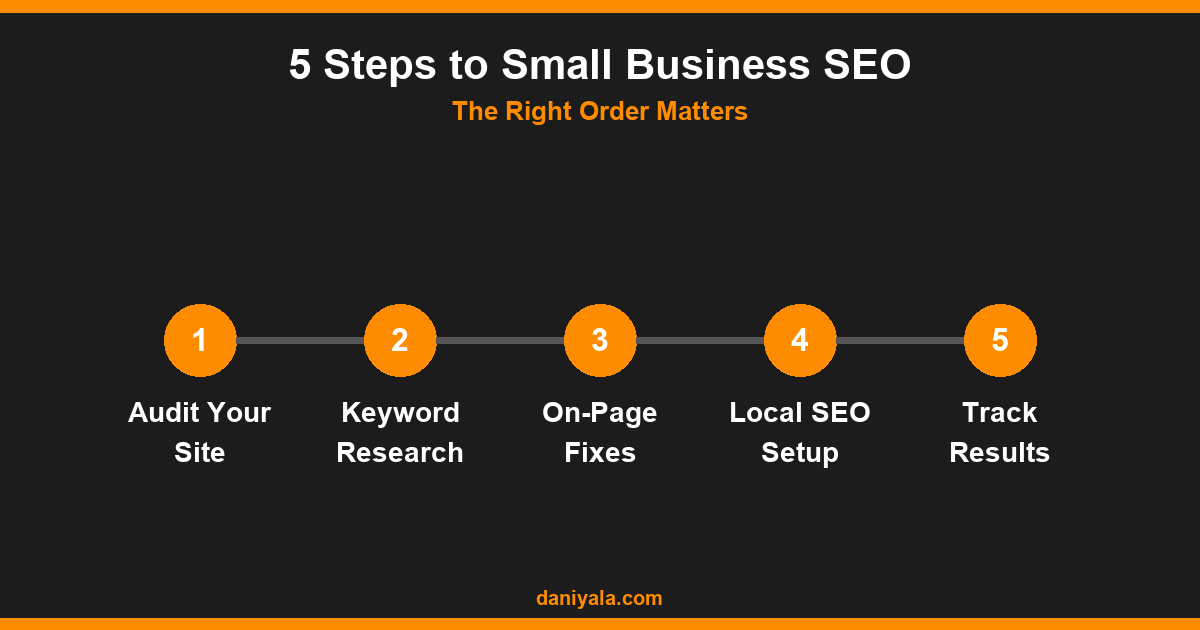
There is no secret formula here. Every small business SEO strategy I build follows these five steps in order. Skip one, and the others do not work as well as they should.
- Audit your site: Find what is already broken — speed issues, missing meta tags, crawl errors — before building anything new.
- Keyword research: Find the specific terms your customers use when they are ready to buy, not just general industry terms.
- On-page optimisation: Make sure every important page is structured correctly for both Google and the person reading it.
- Local SEO setup: If your business serves a geographic area, local signals are your fastest path to ranking.
- Track and adjust: Use Google Search Console (free) to monitor what is working and what needs improving every month.
Most small business owners try to do step three before step one or two, which is why they produce content that never ranks. Sequence matters.
Keyword Research: Find What Your Customers Actually Search For
Good keyword research for a small business is not about finding high-volume head terms — “insurance” or “plumber” — you cannot realistically rank for those yet. It is about finding the specific, buyer-intent phrases your ideal customers type when they are ready to act.
A few starting points I use on every project:
- Google Search Console: If your site has any traffic at all, GSC shows you exactly what queries you already appear for. Position 4–20 queries are your fastest wins — you are nearly there, just needing a content push.
- Google autocomplete: Type your core service into Google and see what it suggests. “Plumber in [city]”, “emergency plumber [city]” — these autocomplete suggestions are real searches.
- People Also Ask boxes: For informational keywords, the PAA boxes tell you what related questions your customers have.
- Your existing customers: Ask your last five clients what they searched before finding you. The exact phrases they use are often better than any tool.
For a proper deep dive on choosing and prioritising keywords, read my keyword research guide — it covers everything from seed keywords to clustering strategy.
On-Page SEO: Quick Wins That Move the Needle
On-page SEO refers to what you control on each page of your site. For a small business with ten to thirty pages, getting on-page right is achievable in a week and pays dividends for years.
The non-negotiables for every page:
- Title tag: Your focus keyword near the start, no more than 60 characters. Every page needs a unique title.
- Meta description: 150–160 characters, includes the keyword, and gives a reason to click. Google sometimes rewrites these, but having a strong one is still worth doing.
- H1 heading: One per page. Contains the focus keyword naturally.
- Internal links: Link your pages together logically. If you have a services page, link to it from relevant blog posts. Internal links pass authority and help Google understand your site structure.
- Image alt text: Every image should have a descriptive alt attribute that includes the keyword where it fits naturally.
If you are running WordPress, a plugin like Rank Math makes filling these fields straightforward. For the full technical picture of what to audit and fix, my technical SEO audit guide walks through every check in order.
Local SEO: Your Biggest Edge as a Small Business
Local SEO is where small businesses win. A national brand cannot rank for “electrician in Chishtian” — but a local electrician with a properly set up Google Business Profile and a few location pages can dominate that query within three to six months.
Local SEO fundamentals:
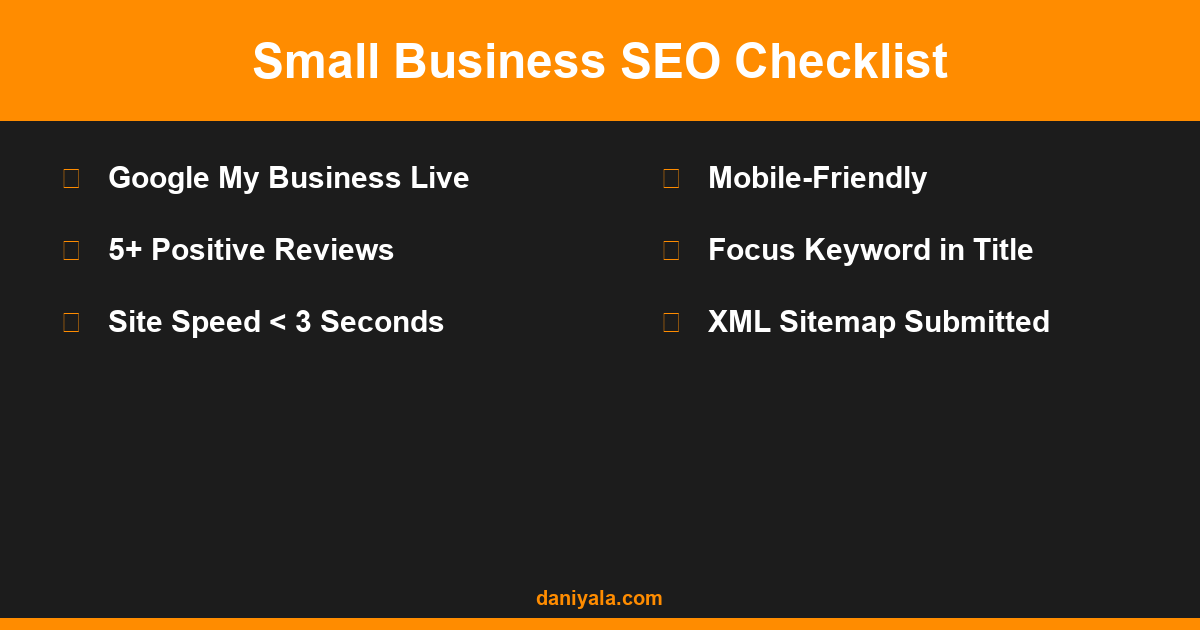
- Google Business Profile: Claim it, verify it, fill every field completely. Add photos, services, and respond to reviews. This is free and has the single highest impact on local search of anything you can do.
- NAP consistency: Your Name, Address, and Phone number must be identical everywhere — your website, GBP, directories, and social profiles. Any mismatch confuses Google and dilutes your local signals.
- Location pages: If you serve multiple cities, create a dedicated page for each one. Not a copy-paste job — genuinely useful content specific to that area.
- Local citations: List your business in relevant local and industry directories. Pakistan-specific directories like PakBusiness.com, Rozee.pk business listings, and industry directories all help.
- Reviews: Ask every satisfied customer for a Google review. Five good reviews can move you significantly in local pack rankings.
Local SEO is the fastest path to results for service businesses. Most of my clients see movement in local pack rankings within sixty to ninety days when GBP is set up properly and citations are consistent.
Technical SEO Basics Every Small Business Site Needs
You do not need to understand every technical SEO concept — but there are a handful of foundational items that, if broken, prevent Google from ranking you no matter how good your content is.
Run through this checklist:
- Site speed: Check your score on Google PageSpeed Insights. A score below 50 on mobile is a serious problem. Common fixes: compress images, enable caching, use a faster host. See my guide to WordPress speed optimisation for the step-by-step.
- Mobile-friendly: Use Google’s Mobile-Friendly Test. In 2026, Google indexes the mobile version of your site first.
- HTTPS: Your site must have a valid SSL certificate. If your URL starts with http://, this is urgent.
- No crawl errors: In Google Search Console, check the Coverage report for 404s, redirect errors, and any pages blocked from indexing that should not be.
- Clean URL structure: URLs should be short and readable: yourdomain.com/services/plumbing/, not yourdomain.com/page?id=12394.
According to Google’s SEO Starter Guide, ensuring your site is crawlable and fast is the foundation everything else rests on. Get this right before investing in content.
How Long Does SEO Take for a Small Business?
I give every small business client the same honest answer: expect three to six months before you see meaningful organic traffic, and six to twelve months before SEO becomes a reliable lead source. That timeline depends on how competitive your market is and how consistently you execute the strategy.
In my experience, the sites that see the fastest results are those that:
- Already have some Google Search Console data (even low traffic)
- Have a technically clean site before starting content work
- Publish consistently (even two to three articles per month) rather than in bursts
- Focus on specific, lower-competition keywords rather than broad head terms
For a detailed breakdown of timeline expectations, read my article on how long SEO takes to work — it covers the factors that speed things up and the mistakes that slow them down.
How Much Does SEO Cost for a Small Business?
Small business SEO ranges from DIY (essentially free, costing only your time) to $300–$800 per month for a local freelancer, to $1,000–$3,000+ per month for a full-service agency. What you should pay depends on your market competitiveness, your current site health, and how fast you want to move.
For most local businesses targeting a single city or region, a budget of $300–$600 per month for a specialist freelancer gets you solid results. For a detailed breakdown of what different service levels include and what fair pricing looks like, see my SEO pricing guide.
DIY vs. Hiring an SEO Specialist
You can absolutely do your own SEO if you are prepared to invest the time to learn it properly. The tools are accessible (Google Search Console and Rank Math are both free), and there is no shortage of reliable education from Google Search Central.
The realistic trade-off: SEO done correctly takes three to ten hours per week to execute — keyword research, writing optimised content, building links, monitoring results. If your time is better spent running your business, hiring a specialist makes sense. If you have capacity and enjoy learning, starting DIY to build understanding before handing off is a sensible approach many of my clients take.
Either way, having a clear understanding of the basics means you can evaluate your SEO provider’s work intelligently, which is worth more than the cost of reading this guide.
Frequently Asked Questions
Does a small business really need SEO or is social media enough?
Social media is good for awareness, but SEO captures demand — people actively searching for what you offer right now. A follower on Instagram might buy from you someday. Someone who finds your site searching “emergency plumber near me” is ready to buy today. For most service businesses, SEO delivers higher-intent leads than social media.
What is the single most important SEO action for a new small business website?
Claim and fully complete your Google Business Profile. It is free, takes one to two hours, and has the most immediate impact on local search visibility of anything you can do. After that, make sure your site loads quickly on mobile and has no crawl errors in Google Search Console.
Can I rank without building backlinks?
For local and niche queries with low competition, yes — especially with a well-optimised GBP and strong on-page signals. For more competitive terms, backlinks remain important. Focus on earning links naturally through genuinely useful content and local citations rather than buying links, which can result in a Google penalty.
How often should I publish new content?
Consistency matters more than volume. Two to four well-researched, properly optimised pieces per month beats ten thin articles per month. Every piece you publish should target a specific keyword your customers search for, not just general industry topics.
What is the difference between local SEO and regular SEO?
Local SEO focuses on ranking in geographically filtered results — the local map pack and “near me” queries. It emphasises Google Business Profile, local citations, and location-specific content. Regular (organic) SEO targets rankings in the standard blue-link results, which are less location-dependent.
Do I need to hire a big agency for small business SEO?
Not at all. For most small businesses, a specialist freelancer with proven local SEO experience outperforms a large agency because you get direct access to the person actually doing the work rather than a junior account manager. Evaluate based on past results and clear monthly deliverables, not agency size.
Need help implementing this? I’m Daniyal — freelance SEO and WordPress expert. Contact me or find me on Upwork.







 by Daniyal © 2026 All Rights Reserved