
Finding the right small business seo services provider is harder than it should be. The market is full of agencies promising page-one rankings and delivering nothing but monthly PDF reports and thin content. As someone who works directly with small business clients on SEO, I want to give you a clear picture of what legitimate SEO services actually look like, what they cost, and how to tell the difference between a provider who’ll move the needle and one who’ll waste your budget for six months.
Table of Contents
What Small Business SEO Services Actually Include
Quality SEO services for small businesses typically cover four areas. Not all providers offer all four — and the split between them tells you a lot about whether the agency is serious.
Technical SEO
This covers the site health fundamentals: crawlability, indexation, page speed, Core Web Vitals, HTTPS, and site architecture. A provider who skips this is building on sand. Technical issues are often the fastest wins — fixing a misconfigured robots.txt or a noindex tag on your service pages can produce ranking improvements within weeks. For a detailed breakdown of what’s involved, the complete technical SEO audit guide covers every element.
On-page SEO and content optimisation
This includes keyword research, meta title and description optimisation, header structure, internal linking, and content quality improvements. On-page SEO is iterative — it’s not a one-time setup but an ongoing process of testing and refinement as you track which pages rank and which don’t.
Content creation
Most small business SEO packages include some volume of blog content or landing page creation each month. The quality and strategy behind this content separates good providers from bad ones. Look for providers who do keyword research before writing and who create content that serves real search intent rather than just hitting a word count.
Link building
Acquiring backlinks from relevant, authoritative websites remains one of the strongest ranking signals Google uses. Ethical link building is slow and resource-intensive — which is why cheap SEO packages either skip it entirely or use low-quality link farms. Any provider quoting very low monthly rates (under $300/month) almost certainly isn’t doing real link building.
Why Small Businesses Need SEO Services
Many small business owners attempt DIY SEO and stall because the workload compounds quickly. A single month of SEO work involves keyword research, content writing, technical fixes, link outreach, and reporting — easily 20–40 hours per month for a serious effort. For most small business owners running their operations day-to-day, this isn’t realistic.
Beyond time, there’s the expertise gap. Tools like Screaming Frog, Ahrefs, and Google Search Console require meaningful experience to interpret correctly. A crawl report showing 400 errors doesn’t tell you which 10 to fix first — that judgment comes from working across many sites.
The guide on SEO for small business covers the full strategy picture if you want to understand the context before hiring someone to execute it.
Types of Small Business SEO Services
Not all SEO engagements are structured the same way. The main models you’ll encounter:
- Monthly retainer: Most common for ongoing SEO. You pay a fixed monthly fee for a defined scope of work (audits, content, reporting). Most small businesses need a minimum six-month commitment for measurable results.
- One-time SEO audit: A comprehensive site audit delivered as a report with prioritised recommendations. No ongoing execution — you implement the fixes yourself or hire separately. Good entry point for small businesses with budget constraints.
- Project-based SEO: A fixed scope with a defined endpoint — for example, a site migration, a local SEO setup, or a technical overhaul. Useful when the work is bounded and well-defined.
- Hourly consulting: Hourly rate for strategic advice, audits, or training your in-house team. Best for businesses that can execute internally but need expert direction.
How Much Do Small Business SEO Services Cost?
Pricing varies significantly by scope, provider experience, and the competitiveness of your market. Here’s a realistic breakdown:
| Service Type | Typical Price Range | What’s Included |
|---|---|---|
| Monthly retainer (basic) | $300–$800/month | On-page + content (2–4 articles), monthly reporting |
| Monthly retainer (full service) | $800–$2,500/month | Technical + on-page + content + link building |
| One-time SEO audit | $300–$1,500 | Full crawl, keyword gaps, priority fix list |
| Local SEO package | $200–$600/month | GBP optimisation, local citations, local content |
The full SEO pricing guide covers these ranges in more detail and explains what drives price differences between providers. Anything below $300/month for ongoing SEO almost certainly means low-quality link building, templated content, or no real strategy behind the work.
How to Choose the Right SEO Provider
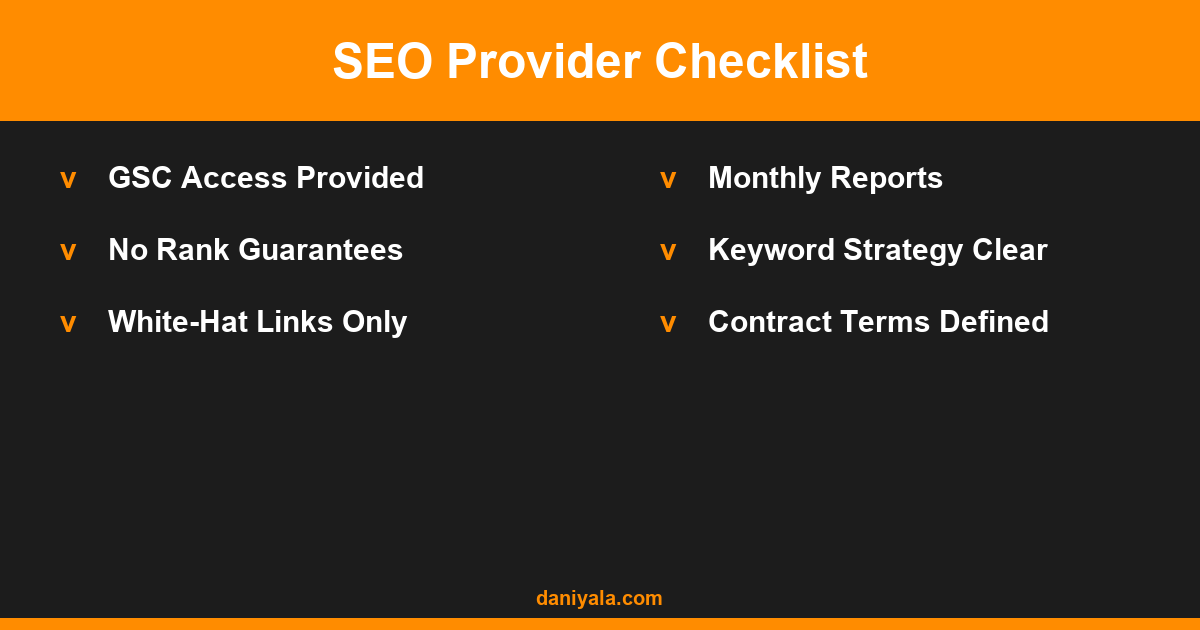
These are the criteria I’d use if I were hiring an SEO provider for a small business:
Ask for case studies with real data
Any serious provider can show you GSC screenshots or Ahrefs traffic graphs from a real client in a similar industry. If they only have testimonials and no data, that’s a red flag. Ask specifically: “What did this site’s organic traffic look like before you started, and what does it look like now?”
Check how they do keyword research
A provider who starts with keyword research tailored to your business (not a generic template) understands that strategy drives execution. Ask them to walk you through how they’d approach keyword research for your site. A good answer includes intent analysis, competitor gap analysis, and a content prioritisation framework.
Avoid guarantees of specific rankings
No legitimate SEO provider guarantees a specific ranking for a specific keyword. Google’s algorithm involves hundreds of signals, and rankings depend on competitor activity, content quality, and technical factors that shift continuously. A provider offering “guaranteed page 1 in 30 days” is either lying or using tactics that will eventually result in a manual penalty.
Confirm white-hat link building practices
Ask directly: “How do you build links?” Legitimate answers involve digital PR, guest posting on relevant blogs, broken link building, and editorial outreach. If the answer is vague or involves “link networks” or “high DA links in bulk,” walk away.
What Results Can You Realistically Expect?
SEO is a long-term channel. For a small business starting from a weak baseline (few rankings, thin content, basic technical health), realistic expectations are:
- Months 1–2: Technical improvements, initial content published, GSC showing increased crawl activity
- Months 3–4: Some new keyword rankings appearing, especially for lower-competition long-tail queries
- Months 5–6: Measurable organic traffic growth, early signs of lead generation from organic
- Months 7–12: Compounding growth as content builds authority and link profile strengthens
Markets with high competition (e.g., lawyers, dentists in major cities) take longer. Local niches and B2B service businesses in moderately competitive markets typically see meaningful movement by month four or five.
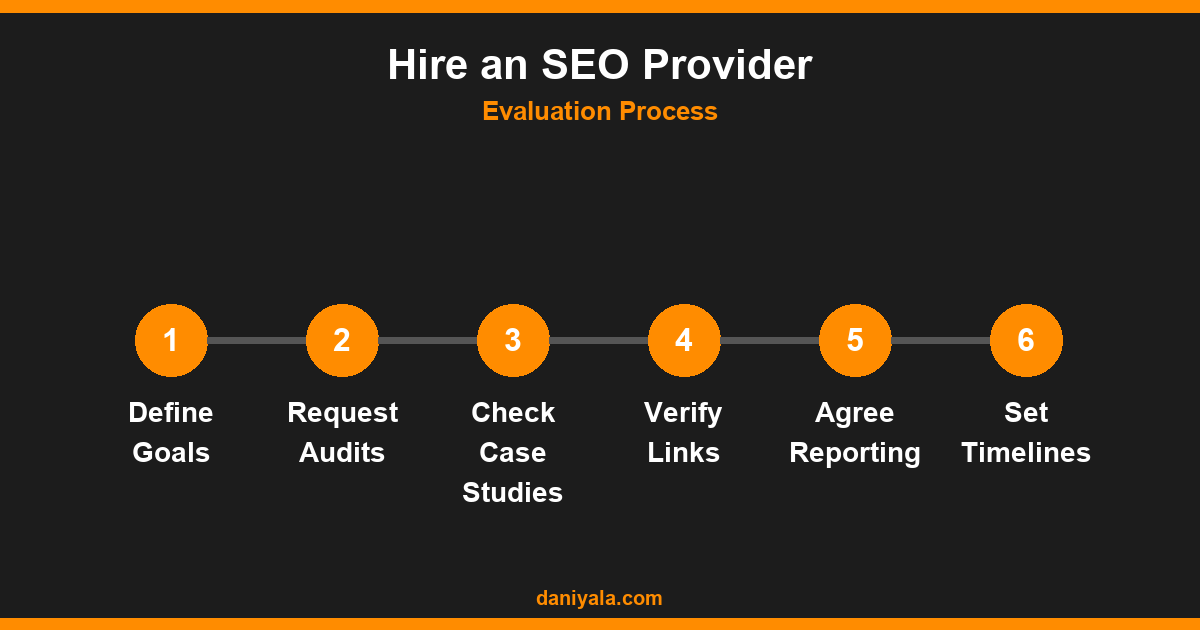
The guide on SEO services for small business has more detail on the evaluation process and what questions to ask potential providers.
Frequently Asked Questions
What should small business SEO services include as a minimum?
At minimum: a technical SEO audit, keyword research aligned to your business goals, on-page optimisation of key pages, and monthly reporting with GSC data. Content creation and link building are essential for competitive markets but may be phased in based on budget. Avoid any provider who can’t explain what they’re doing and why.
How long does it take to see results from small business SEO services?
Most legitimate SEO services produce visible ranking improvements within three to six months on moderately competitive keywords. Technical fixes can show results faster — sometimes within four to six weeks in GSC crawl stats. For highly competitive markets or a new domain, allow 9–12 months for meaningful organic traffic growth.
Is local SEO different from general SEO services?
Yes. Local SEO focuses on ranking in Google Maps and local search results (“near me” queries), which requires optimising Google Business Profile, building local citations, acquiring reviews, and creating location-specific content. General SEO focuses on organic search rankings across any geography. Many small service businesses need both, but local SEO often delivers results faster for service-area businesses.
Can a freelancer provide the same quality as an agency?
Frequently, yes — and often at lower cost. A senior freelancer with five or more years of experience typically outperforms a mid-tier agency on strategy and execution. The difference is bandwidth: a freelancer may not have capacity for large-scale content production or simultaneous technical and link-building work. For most small businesses, a skilled freelancer is a better value than a full-service agency at the same budget level.
What are the red flags to avoid when hiring an SEO provider?
Watch for: guaranteed rankings within 30 days, pricing well below $300/month for “full service,” no transparency on what links they build, reliance on keyword stuffing or thin auto-generated content, and refusal to provide a plain-language explanation of their strategy. Also avoid providers who won’t grant you access to your own GSC and Google Analytics accounts.
Need help implementing this? I’m Daniyal — freelance SEO & WordPress expert. Contact me or find me on Upwork.






 by Daniyal © 2026 All Rights Reserved