
When small business owners search for SEO services for small businesses, they usually get two things: vague promises and confusing pricing. Some agencies quote $500/month, others $5,000 — and neither explains clearly what’s actually included. Having worked with small business clients on SEO and WordPress for several years, I’ve seen what separates providers that move rankings from those that generate reports but nothing else.
This guide covers what good SEO services actually include for small businesses, what realistic pricing looks like, what to ask before signing anything, and the red flags that tell you to keep looking.
Table of Contents
What SEO Services for Small Businesses Actually Include
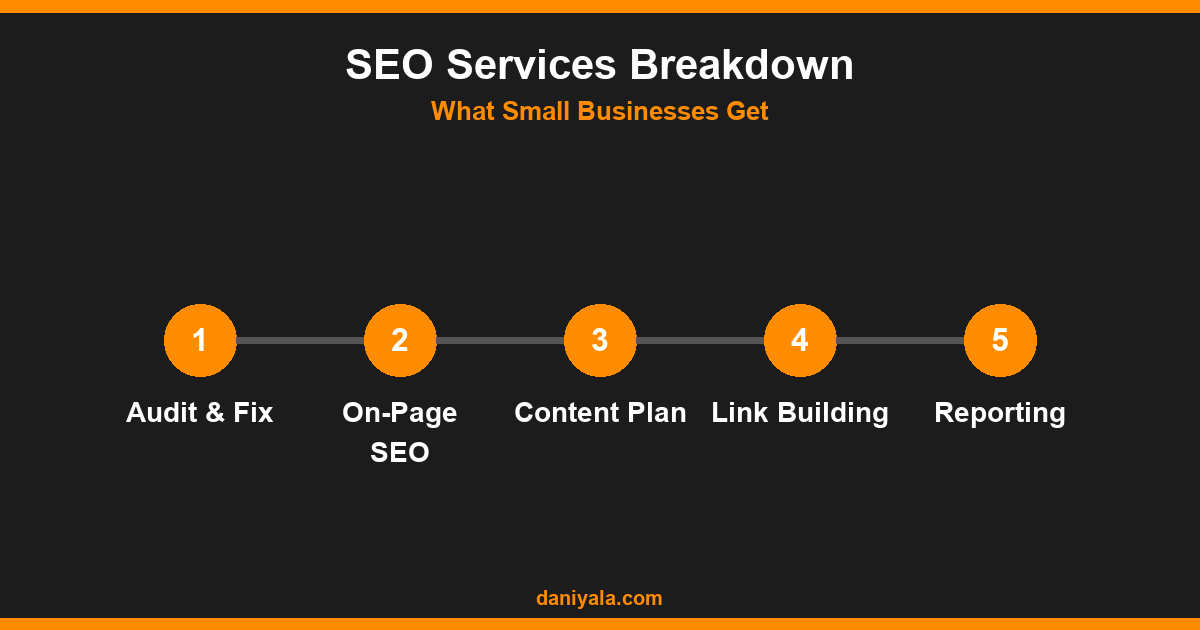
Not all SEO services are the same, and scope varies significantly by price and provider. But a legitimate small business SEO engagement should cover these core areas:
Technical SEO Audit and Fixes
The starting point for any real SEO engagement. A technical audit identifies crawl issues, indexing problems, slow pages, and structural errors that prevent Google from ranking your site. The key word here is “fixes” — you’re paying for problems to be resolved, not just identified. If a provider audits your site and hands you a spreadsheet of issues without fixing them, that’s not a full-service engagement.
On-Page Optimization
This covers title tags, meta descriptions, header structure (H1, H2s), internal linking, and page content optimization for your target keywords. On-page work should happen in the first 30–60 days of any engagement and should be revisited as new content is published.
Keyword Research and Content Strategy
Good SEO services identify the specific queries your potential customers use — not just broad terms but the long-tail questions and commercial phrases that drive actual leads. For most small businesses, a content calendar of 4–8 targeted articles per month compounds over time into significant organic traffic.
Local SEO (if applicable)
For businesses with a physical location or geographic service area, local SEO is critical — Google Business Profile optimization, local citation building, and schema markup for local business. This is often the fastest path to measurable results for service businesses.
Link Building
Acquiring links from relevant, authoritative sites is one of the factors Google uses to determine how much to trust your domain. Quality matters enormously here — five links from real, relevant websites are worth more than fifty from spam directories. Good link building is slow, methodical work. Any provider promising rapid link results is using tactics that carry long-term risk.
Monthly Reporting
You should receive a monthly report showing keyword rankings, organic traffic trends, links acquired, and work completed. Good providers connect their report to Google Search Console and Analytics data — not a custom platform where you can’t verify the numbers independently.
For a detailed breakdown of costs, my SEO pricing guide covers what each of these service components typically costs and how to evaluate quotes intelligently.
Realistic Pricing for Small Business SEO Services
Here’s what you’re actually looking at in the current market:
- $300–$600/month: Freelancer-level SEO, typically limited to 1–2 service areas (on-page only, or content only). Can deliver results for low-competition local niches. Not sustainable for competitive industries.
- $700–$1,500/month: Mid-market freelancer or boutique agency. Full-scope but with a smaller team. Good fit for small businesses with modest competition and clear geographic focus. Most realistic starting point for genuine multi-channel SEO.
- $1,500–$3,000/month: Established agency or senior freelancer team. Appropriate for businesses in competitive industries or operating in multiple locations. Includes comprehensive content production and active link acquisition.
- Below $300/month: Typically report-only services, templated content farms, or offshore providers who cannot explain their strategy. Not recommended as a primary SEO investment.
Monthly retainers are the standard model because SEO is ongoing. One-time audits exist but won’t move rankings — they’re useful for identifying what needs to be fixed, not for doing the fixing.
Whether SEO is the right investment for your business at this stage is a question worth thinking through carefully. My article on whether SEO is worth it for small business covers the ROI math and the circumstances where it makes sense to invest versus wait.
What to Look for in an SEO Provider
Before signing a contract, ask these questions and pay attention to how the answers land:
Can you show me results from similar clients?
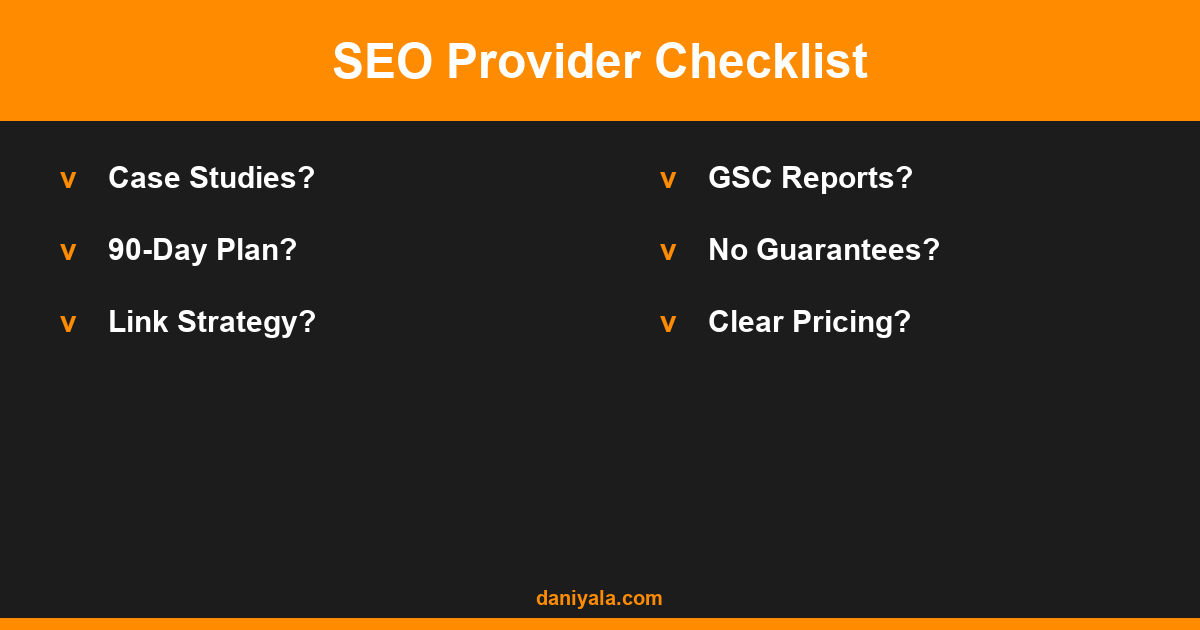
Legitimate SEO providers have case studies or examples they can share — rankings moved, traffic grown, leads increased for businesses like yours. They don’t need to share confidential data, but they should be able to speak specifically about results they’ve achieved in your industry or for businesses of your size. Generic testimonials and vague claims aren’t enough.
What specifically will you do in the first 90 days?
The answer should be specific: technical audit and fixes in weeks 1–4, on-page optimization for your top 10 pages in weeks 4–8, content publication beginning in month 2, and reporting throughout. If the answer is “we’ll run the campaign and monitor performance,” keep looking.
How do you build links?
This is where you separate the good from the risky. Legitimate link building involves outreach to relevant websites, content partnerships, and earning placements through genuinely useful content. If the answer involves “link networks,” “high-DA directory submissions,” or purchasing links in bulk, those are tactics that Google actively penalizes. The risk doesn’t usually materialize in the first few months — it shows up later as a penalty that’s difficult to recover from.
What does your reporting include and how often?
Monthly reporting against GSC data is the baseline standard. Any provider who can’t connect their report to your actual Google Search Console numbers is showing you data you can’t verify.
For a broader view of what a strong SEO strategy for a small business looks like — not just the service components but the actual approach — my guide to SEO for small business covers the full playbook, including how to prioritize when you have a limited budget.
Red Flags That Tell You to Walk Away
Having evaluated a fair number of SEO providers alongside clients, these are the warning signs I see before things go wrong:
- Guaranteed rankings — No one can guarantee a specific position in Google’s search results. Anyone who does is either misleading you or planning to use tactics that will eventually hurt your site.
- No explanation of strategy — If you can’t get a plain-English explanation of what they’ll actually do and why, they don’t have a strategy worth explaining.
- Locked-in long contracts without clear deliverables — 12-month contracts with no defined monthly deliverables are designed to protect the provider, not you. Reasonable contracts define what gets done each month.
- Immediate results promised — SEO takes time. Real results for small businesses typically emerge between 3–6 months. Providers promising significant results in weeks are describing either paid ads (not SEO) or short-term tactics with long-term risk.
- Access restrictions — You should always have admin access to your own Google Search Console and Analytics accounts. Providers who insist on managing access through their own accounts rather than yours are not operating transparently.
Agency vs. Freelancer vs. DIY: Which Makes Sense?
For most small businesses, the choice comes down to budget and complexity:
- Agency: More resources, structured process, but higher cost and sometimes less direct communication with the person actually doing the work. Good for businesses that want managed service without involvement.
- Freelancer (or small freelance team): Direct access to the person managing your SEO, often more flexible and transparent. Best fit for businesses with specific, well-defined needs. The risk is capacity — a single freelancer has limits on what they can deliver per month.
- DIY: Feasible for simple, local businesses in low-competition niches. Requires learning time investment and consistent execution. I’d recommend starting with at least one professional audit before attempting full DIY — you need to know what’s actually wrong before you can fix it.
Whatever direction you go, my guide on the best SEO strategies for small business covers the specific tactics that move the needle most consistently — useful both for evaluating providers and for understanding what good work looks like.
Google’s own SEO Starter Guide is worth reading as a baseline — it explains what Google expects from websites and is directly useful when evaluating whether a provider’s strategy aligns with how search actually works. Setting up and verifying your Google Search Console account is free and should be done immediately regardless of which provider you choose.
Frequently Asked Questions
How long does it take for SEO services to show results for small businesses?
For most small businesses, meaningful organic traffic improvements appear between 3–6 months after a proper engagement begins. Competitive industries or businesses with serious technical issues can take longer. Local SEO (Google Business Profile optimization and local pack rankings) often moves faster — some improvements appear within 4–8 weeks. Anyone promising significant rankings improvement in weeks is either selling paid ads or using high-risk tactics.
Should I do SEO or Google Ads first?
For most small businesses with a limited budget, I recommend a small Ads spend to generate leads while SEO builds — not one or the other. Ads give you immediate traffic and help you identify which keywords convert, which informs the SEO strategy. After 3–4 months, organic traffic starts contributing, and you can gradually reduce Ads spend. Doing SEO alone with no traffic for 6 months is difficult to sustain for businesses that need leads now.
Can I do SEO myself instead of hiring a service?
Yes, particularly for low-competition local niches. DIY SEO requires learning the basics of technical SEO, keyword research, and content creation — and then executing consistently over months. Most business owners find the time investment difficult to sustain alongside running the business. A hybrid approach — hire for technical and strategy, DIY for content — is often the most practical path for budget-constrained businesses.
What is a realistic budget for small business SEO services?
A realistic starting budget for genuine, multi-channel SEO services is $700–$1,500 per month. Below $500/month, most services are limited in scope — on-page only, or content only, without active link building or technical work. The right budget depends on your industry’s competition level and your market geography. A local plumber in a mid-size city needs less budget than a law firm competing nationally.
Do I need to sign a long-term contract for SEO services?
Reputable providers typically ask for 3–6 months minimum — enough time for SEO to show measurable results. 12-month contracts with locked-in terms and no defined deliverables are a red flag. The best arrangement is a clear monthly scope of work with a 3–6 month initial commitment, reviewed and renewed based on results.
Looking for honest SEO services for your small business? I’m Daniyal — freelance SEO & WordPress expert with 70+ projects and 45+ five-star clients. Contact me or find me on Upwork.














 by Daniyal © 2026 All Rights Reserved