
Is SEO worth it for small business? It is one of the most honest questions I get from small business owners, and I appreciate it every time. They have limited budgets, limited time, and real pressure to see returns. Having worked on SEO for small business clients across multiple industries, I can give you a direct answer: SEO is worth it for most small businesses — but not all, not always immediately, and not without a realistic plan.
This guide walks you through the real costs, the honest timelines, and a simple framework to decide whether SEO makes sense for your specific situation right now.
Table of Contents
- What “Worth It” Actually Means in SEO
- What SEO Delivers for Small Businesses
- The Real Costs of SEO for Small Businesses
- How Long Before SEO Starts Working?
- When SEO Is Clearly Worth the Investment
- When SEO Might Not Be the Right Move Yet
- How SEO Compares to Other Channels
- How to Evaluate SEO for Your Specific Business
- Frequently Asked Questions
What “Worth It” Actually Means in SEO
Before evaluating ROI, you need to define what success looks like. “Worth it” is not the same for every business. For a local plumber, it means appearing in Google Maps when someone in their area types “emergency plumber near me.” For a freelance consultant, it means ranking on page one when a potential client searches their specific service. Worth it means the return — leads, sales, visibility — exceeds the cost in time, tools, and fees.
The challenge is that SEO has a delayed payoff. You invest now and see results in 3–12 months. That time delay makes many business owners dismiss it — they compare SEO to a paid ad that delivers clicks tomorrow, and SEO looks slow. But paid traffic stops the moment you stop paying. SEO traffic continues, compounds, and often grows without additional cost per click. That asymmetry is the whole value proposition of the channel.
What SEO Delivers for Small Businesses
Here is what I see SEO deliver consistently for small businesses when approached correctly:
- Consistent organic traffic — visitors who are actively searching for what you offer, not people you interrupted with an ad.
- Local visibility — appearing in Google Maps and local pack results for nearby customers who are ready to buy.
- Lower cost per lead over time — once you rank, each lead has essentially zero marginal cost, unlike PPC where you pay per click indefinitely.
- Credibility signals — ranking on page one signals authority to potential customers who are comparing you against competitors.
What SEO does not deliver: immediate results, guaranteed rankings, or leads if your website cannot convert visitors once they arrive. A full technical SEO audit is always the first step, because crawl errors, slow load times, and broken pages will undermine any content investment.
The Real Costs of SEO for Small Businesses
There are three practical ways to approach SEO for a small business, each with different cost and time profiles:
| Approach | Monthly Cost | Your Time | Best For |
|---|---|---|---|
| DIY SEO | $0–$100 (tools) | 10–20 hrs/month | Solopreneurs, bloggers |
| Freelance SEO | $300–$1,500 | 1–3 hrs/month | Small local businesses |
| SEO Agency | $1,000–$5,000+ | Minimal | Established SMBs |
For most small businesses starting out, a freelance SEO with a clear deliverables list and monthly reporting is the sweet spot — you get professional execution without the overhead of an agency retainer. For a breakdown of what you actually get at each price point, the guide on SEO services for small business covers this in detail.
How Long Before SEO Starts Working?
The honest timeline I give every client:
- Months 1–2: Technical fixes, on-page optimisation, Search Console setup. No visible ranking movement yet, but the foundation is being built.
- Months 3–4: New content indexes. Impressions in GSC start rising even if clicks are still low.
- Months 5–6: Rankings for lower-competition terms appear in positions 10–30. Traffic starts trickling in.
- Months 7–12: Consistent work translates to meaningful traffic gains. ROI becomes measurable for most niches.
Local SEO moves faster than national campaigns because competition is lower and Google Business Profile optimisation can generate leads in weeks. If you serve a specific city or region, that is where to start — it is the fastest-ROI version of SEO for a small business.
When SEO Is Clearly Worth the Investment
SEO makes the strongest case for itself in these situations:
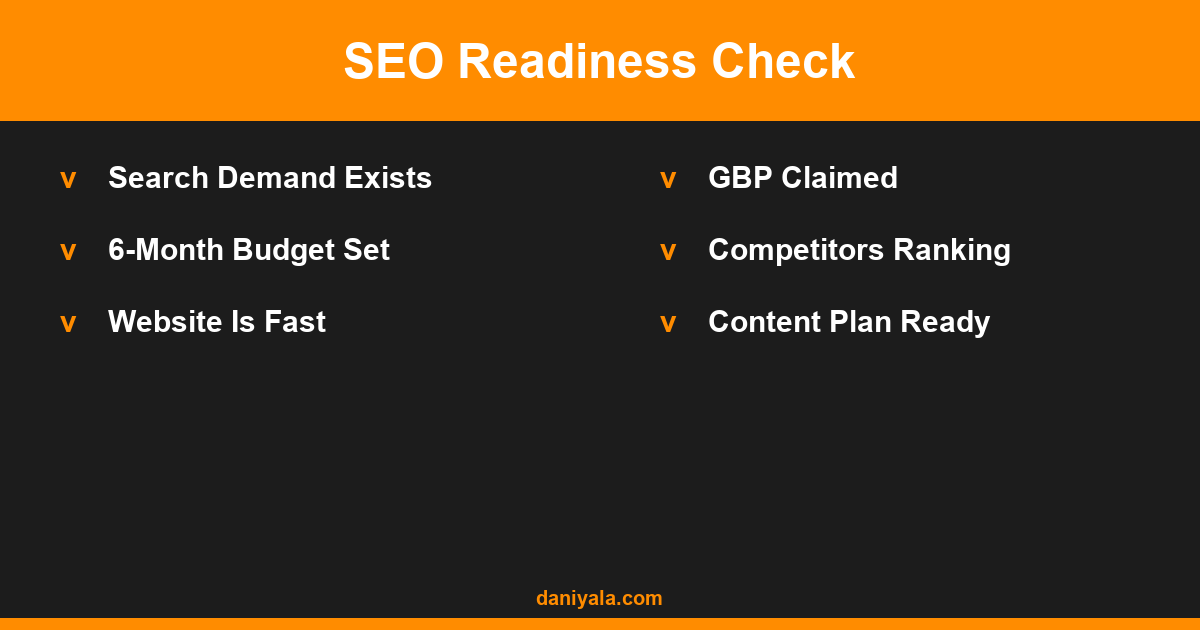
- People are already searching for what you sell. If your service or product has measurable search volume, organic traffic is a real opportunity. Check Google Search Console if your site is live, or use a free keyword tool to verify demand.
- You have a 6–12 month runway. If you need clients next week, SEO is not the answer. If you can invest now for returns in six months, it makes sense.
- Your competitors are getting organic traffic. If competitors rank on page one and you are not, you are losing customers who would otherwise choose you.
- Your average client lifetime value is meaningful. A single lead that converts into a $3,000–$5,000 project justifies months of SEO spend. A business where each transaction is $20 needs high volume to make the numbers work.
When SEO Might Not Be the Right Move Yet
I tell clients honestly when SEO is not the priority right now:
- Your website is not functional, slow, or broken on mobile. Fix this before spending on SEO.
- You have no capacity for content — SEO without regular publishing is extremely slow.
- You operate in a niche with no search volume. Ranking for something nobody searches for delivers nothing.
- You need revenue within 30 days. Use paid ads or direct outreach first, then layer in SEO as a long-term investment once cash flow is stable.
How SEO Compares to Other Channels
Comparing is important. Here is how SEO stacks up against what most small businesses use:
| Channel | Speed | Cost Over Time | Sustainability |
|---|---|---|---|
| SEO | Slow (3–12 months) | Decreasing per lead | High — compounds over time |
| Google Ads | Fast (days) | Fixed per click forever | Low — stops when budget stops |
| Social Media | Medium | Medium (time-intensive) | Medium — algorithm-dependent |
| Referrals | Variable | Low | Unpredictable |
The most resilient small business marketing strategy combines SEO for long-term organic traffic with a small PPC budget for immediate leads during the early months. When SEO takes hold, you reduce PPC spend and your cost per lead drops. For a full picture of what running SEO alongside paid activity looks like, the guide on small business SEO services includes provider comparisons and budget frameworks.
How to Evaluate SEO for Your Specific Business
Run this quick assessment before committing:
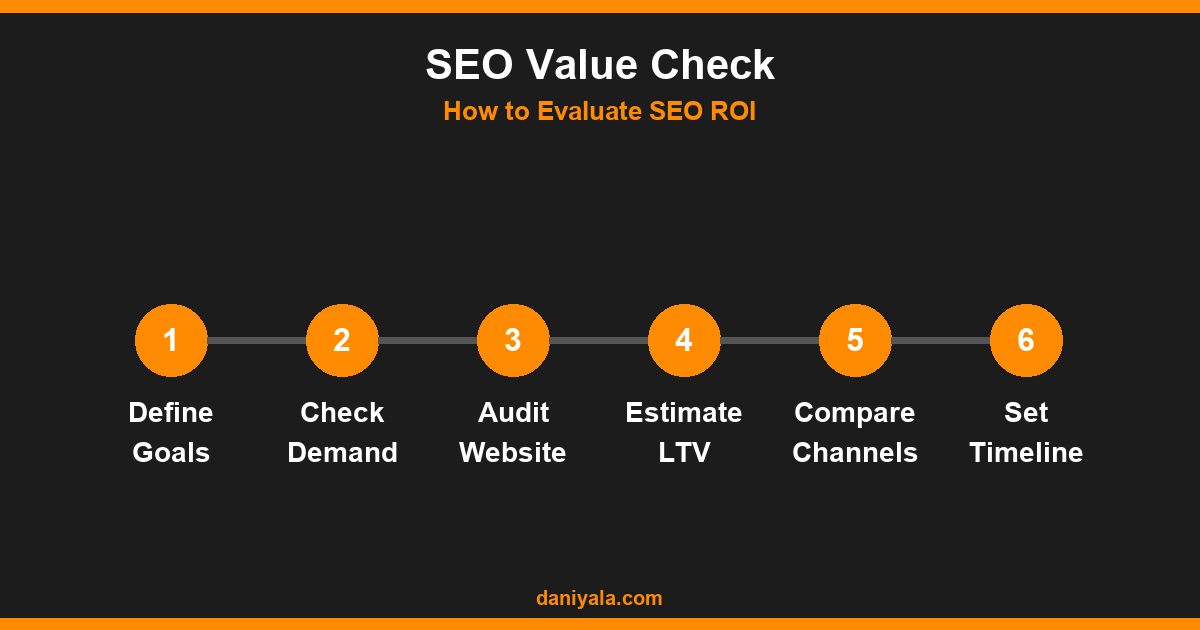
- Verify search demand: Open Google Search Console (if your site is live) and check if queries are already bringing impressions. If people are finding you but not clicking, that is an SEO opportunity. If there are zero impressions, verify that search demand actually exists in your niche.
- Audit your website foundation: A site that loads slowly, is not mobile-friendly, or has no SSL certificate will drag down every SEO effort. Fix the foundation before adding content.
- Calculate your break-even: Divide your annual SEO budget by your average deal value. If you need 5 leads to break even and organic search could realistically bring 10+ leads per month within a year, SEO has a positive expected return.
- Check the competitive landscape: If the top three results in your local area are thin, poorly-reviewed local businesses, you can compete. If they are national brands with deep content libraries and thousands of backlinks, narrow your focus to hyper-local and long-tail terms first.
For broader guidance on what Google’s ranking systems actually evaluate — content quality, page experience, authority — that context is useful before setting SEO expectations. And if cost is your main concern before committing, the SEO pricing guide breaks down exactly what you get at each investment level.
Frequently Asked Questions
How much does SEO cost for a small business?
Freelance SEO typically runs $300–$1,500 per month for small businesses. DIY with tools like Google Search Console and a free keyword planner costs almost nothing. Agency packages start at $1,000 per month and rise steeply. For most small businesses, starting with a freelancer who offers monthly reporting and clear deliverables gives you professional results at a reasonable cost.
Can a small business do SEO on their own?
Yes, but it takes consistent effort. DIY SEO means learning keyword research, on-page optimisation, and content creation — and keeping up with how Google’s algorithms evolve. Many small business owners handle basic on-page SEO themselves and outsource the more technical work such as site speed, structured data, and link building.
How long does it take to see results from SEO?
Most small businesses see meaningful ranking movement between months 3 and 6, with measurable traffic and lead increases between months 6 and 12. Local SEO tends to move faster than national SEO. The timeline depends heavily on your starting position, how competitive your niche is, and how consistently you produce and optimise content.
Is local SEO different from regular SEO?
Yes. Local SEO focuses on ranking in your city or region — in Google Maps, local pack results, and location-specific queries. It involves optimising your Google Business Profile, building local citations, and earning reviews. For most small businesses serving a geographic area, local SEO produces the fastest return and should be prioritised before broader organic campaigns.
What happens if I stop doing SEO?
Rankings gradually decline when SEO work stops, particularly for pages in competitive spaces. High-authority pages can hold positions for months or longer without active maintenance. The practical approach: once you have meaningful rankings, reduce to quarterly maintenance updates rather than stopping entirely. Protecting existing rankings costs far less than rebuilding them from scratch.
Need help implementing this? I’m Daniyal — freelance SEO & WordPress expert. Contact me or find me on Upwork.




 by Daniyal © 2026 All Rights Reserved