

Learning how to become a freelance seo expert is one of the highest-ROI career moves in digital marketing. SEO skills compound over time, translate directly into client results, and can be learned without a degree or formal training. I started taking on SEO clients while still building my own skills — the gap between “learning SEO” and “getting paid for SEO” is smaller than most people expect. This guide walks through how to build the skills, create proof of results, find clients, and grow a sustainable freelance SEO income from scratch.
For the broader freelancing journey — platform strategy, proposals, and client management — see the complete freelancing guide.
Table of Contents
What Freelance SEO Work Actually Involves
Before investing months in learning, it helps to understand what clients actually hire freelance SEO specialists to do. The scope is broader than most beginners expect, and knowing this shapes where you direct your learning effort.
Core services freelance SEO specialists deliver:
- Technical SEO audits — crawling a site with Screaming Frog, identifying indexing issues, Core Web Vitals failures, redirect chains, duplicate content, and broken links. Delivered as a structured report with prioritised action items
- On-page optimisation — updating title tags, meta descriptions, internal linking structures, heading hierarchies, and content gaps on existing pages
- Keyword research — identifying target keywords by search intent, volume, and difficulty, then mapping them to existing or planned content
- Content planning and briefs — creating structured briefs for blog posts, landing pages, and pillar content based on keyword research and SERP analysis
- Local SEO — optimising Google Business Profiles, building local citations, and improving map pack rankings for service businesses
- Monthly reporting — presenting organic traffic data from Google Search Console and Google Analytics in formats non-technical clients understand
Most freelance SEO engagements combine 2–3 of these service areas. Niching into one area — for example, technical SEO audits for WordPress sites — makes you easier to find and simpler to price competitively.
Build the Core Technical Skills
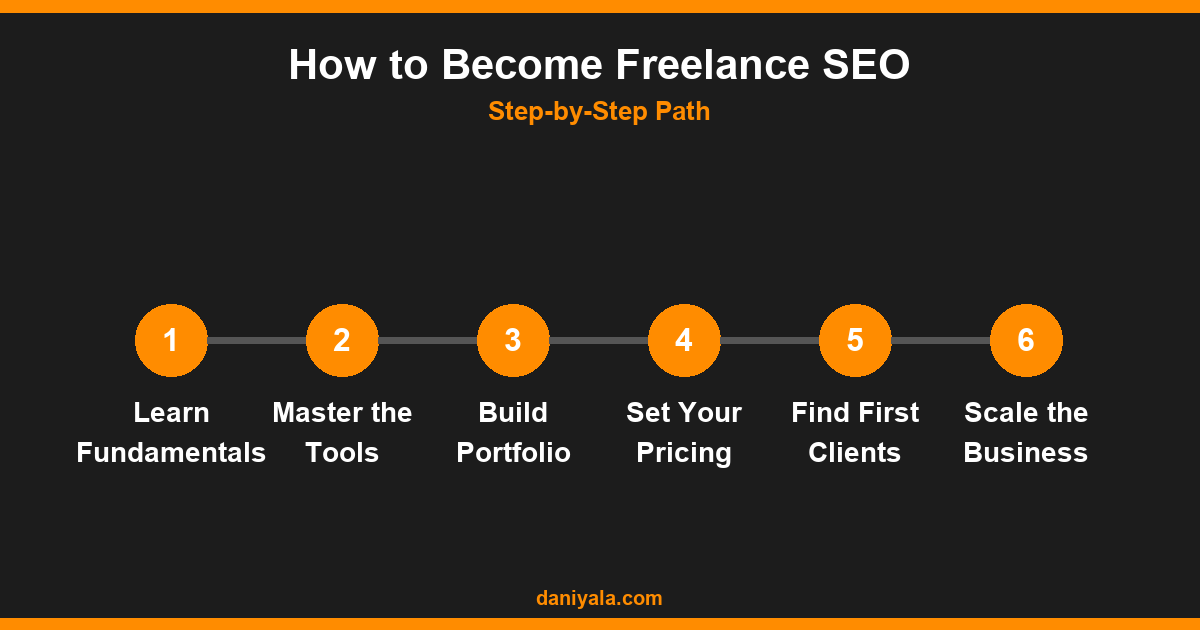
The good news: SEO can be learned systematically, and the best resources are largely free. The key is learning in a structured order rather than consuming random blog posts and YouTube videos without a framework.
The learning path I would follow starting from zero:
- Google Search Essentials — read Google’s Search Essentials documentation (formerly Webmaster Guidelines). Understanding what Google says it values is the starting point for everything else. Don’t skip this step
- Technical SEO — understand crawling, indexing, sitemaps, robots.txt, canonical tags, and Core Web Vitals. The technical SEO audit guide on this site covers these systematically with the audit process I use on real client sites
- Keyword research — learn to use Google Search Console and at least one third-party tool (Ahrefs, Semrush, or their free alternatives) to find keyword opportunities by search volume, intent, and ranking difficulty
- On-page SEO — learn how to structure pages for a target keyword: title tag, H1 placement, internal links, content depth, and schema markup
- Link building fundamentals — understand domain authority, what characteristics make a backlink valuable, and why link building is often a separate specialisation rather than a core service for most freelancers starting out
This foundation takes 3–6 months to genuinely absorb if you are actively optimising a test site while learning. Book learning without hands-on practice doesn’t build the pattern recognition that clients are paying for. Build something, measure it, fix it, measure again.
Learn the Essential SEO Tools
Clients expect you to work with industry-standard tools. Proficiency in these tools isn’t optional — it’s table stakes for credibility in client conversations.
- Google Search Console — free and indispensable. Log in at search.google.com/search-console to monitor indexing status, Core Web Vitals, search query data, and manual actions. Every serious SEO engagement starts with verifying GSC access and reviewing the Coverage report
- Google Analytics 4 (GA4) — understand organic traffic trends, landing page performance, and goal tracking. Clients judge SEO results by GA4 reports
- Screaming Frog SEO Spider — the industry-standard site crawler. The free tier crawls up to 500 URLs, which covers most small business clients. Learn to interpret the crawl output systematically
- Ahrefs, Semrush, or Moz — for keyword research, backlink analysis, and competitive research. Free tiers have limitations; a paid subscription ($99–$129/month) pays for itself quickly once you are billing clients
- Google PageSpeed Insights — analyse Core Web Vitals and communicate performance data to clients. Available via developers.google.com
Don’t try to master every tool simultaneously. Start with Google Search Console and Screaming Frog — these two tools alone can deliver a solid technical audit for most small business clients and form the foundation of every engagement I run.
Build Your Portfolio With Real Results
No portfolio means no clients. The path to a first paying client requires demonstrable proof that you can move rankings. Here is how to build that proof from scratch without needing to wait for someone to hire you first.
Build and rank your own site: Create a blog or niche site targeting a handful of low-competition keywords and optimise it over 3–6 months. Rankings, traffic growth, and GSC screenshots are your evidence. Clients understand “I built a site that now ranks on page 1 for these keywords” far better than any certification. This approach also teaches you SEO under real conditions — not controlled case studies.
Offer free audits to local businesses: Approach 3–5 local businesses with a free technical audit, delivered as a well-formatted PDF with specific action items and priority tiers. You are not asking for work — you are demonstrating what you can find. Some will convert to paid engagements; all become portfolio pieces and references. For the types of improvements small businesses value most, see the SEO for small business guide.
Document everything as case studies: Publish case studies on your own site. Even modest results — 15% traffic increase, 3 new first-page rankings in a specific city — are compelling when written up with before-and-after screenshots from GSC. A written case study with data is worth more than any badge or certificate on your profile.
Set Your Pricing
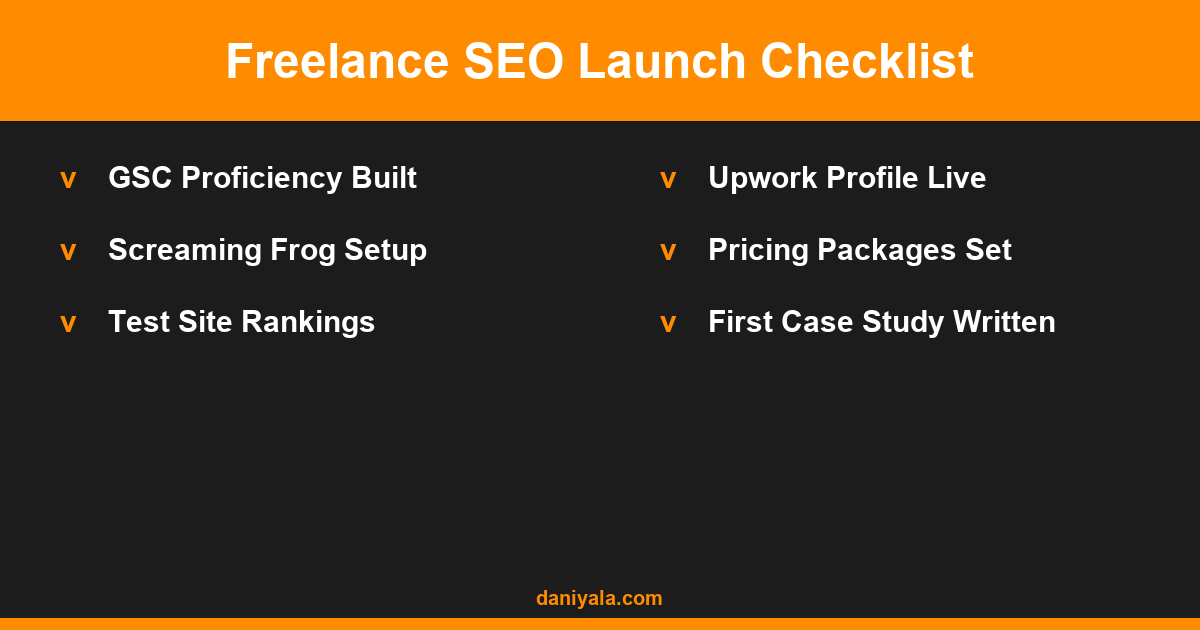
Pricing is the part most beginners get wrong, almost always by charging too little. Underpricing signals low quality to experienced buyers and traps you in a high-volume, low-margin cycle that leads to burnout without building a sustainable business.
Realistic freelance SEO pricing ranges in 2026:
- One-time technical audit: $150–$800 depending on site size and report depth. A thorough 10–15 page audit report for a 50-page site, with prioritised action items, is worth $300–$500
- Monthly retainer: $300–$1,500/month for ongoing management — keyword tracking, monthly reporting, on-page updates, and content guidance. Most full-service retainers for small businesses fall in the $400–$800 range
- Hourly consulting: $40–$120/hour for experienced specialists. Use this for strategy calls and ad hoc questions, not deliverable-based work
For a complete breakdown of what clients pay for SEO services and how to structure packages competitively, see the SEO pricing guide.
Retainers are better than one-time projects because they create predictable income. But start with one-time audits to build portfolio evidence and client trust before pitching ongoing work. Once a client has seen your audit quality, the retainer conversation becomes much easier.
Find Your First Clients
The platforms and channels that consistently produce SEO clients for freelancers:
Upwork: The most accessible platform for beginners. Start at a competitive rate to build reviews quickly, then raise rates after 5+ positive reviews and a solid Job Success Score. The Upwork algorithm rewards completion rate and client satisfaction heavily — be selective about which projects you accept early on. A poor early review sets back your profile significantly.
LinkedIn: Better for higher-value B2B clients once you have a track record. Connect with small business owners and marketing managers, comment genuinely on relevant posts, and share your own insights about SEO findings you’ve discovered. Relationships convert to clients over weeks and months, not overnight.
Local networking: Chamber of commerce events, local business groups, and sector-specific meetups connect you with business owners who need their sites found on Google but don’t understand how. Face-to-face trust builds faster than any digital channel and produces clients who are easier to work with and more likely to refer you.
Referrals: Ask satisfied clients directly for referrals — most won’t volunteer them without being asked. Offer a one-month retainer discount as an incentive. Referral clients close faster and accept higher rates because trust is already established before the first conversation.
Scale From Freelancer to SEO Business
Once you have 3–5 retainer clients, scaling becomes about systems rather than more hours. The ceiling on solo freelancing is real — the path forward is building processes that allow you to serve more clients without proportionally more time.
Key scaling steps:
- Systematise deliverables: Build templates for audits, monthly reports, and keyword research presentations. Reduce time per client by 30–50% without reducing quality
- Raise prices with each new client cohort: If you are consistently fully booked, you are underpriced. Increase rates for new clients every 6 months and grandfather existing clients at current rates
- Add adjacent services: WordPress development, Elementor redesigns, and email marketing setup are adjacent services that existing SEO clients often need and naturally trust you to deliver
- Subcontract to scale: Bring in a junior specialist to handle reporting and research while you focus on strategy, client communication, and business development
Frequently Asked Questions
How long does it take to become a freelance SEO expert?
With focused study and hands-on practice on a test site, you can deliver basic SEO audits and on-page optimisation within 3–6 months. Reaching a level where clients consistently pay $500+/month retainers typically takes 12–18 months of active client work and visible, documented results. SEO skill development is continuous — algorithm changes and SERP format evolution mean staying current is a permanent part of the job.
Do you need a certification to become a freelance SEO expert?
No. Certifications from Google, Semrush, or HubSpot are useful for structuring your learning and add a credential line to your profile, but they don’t replace demonstrated results. A portfolio with real ranking improvements outweighs any certificate in a client conversation. Clients hire you for outcomes — show them you can deliver through case studies and trial projects rather than leading with credentials.
What’s the difference between freelance SEO and in-house SEO?
In-house SEO means working for one company with stable income, a defined scope, and usually a limited budget for tools and experimentation. Freelance SEO means working across multiple clients simultaneously, with variable income but higher per-hour earnings potential and freedom to specialise in the areas you find most valuable. Freelancers also take on business development, client management, and invoicing as part of the role.
Can you start freelance SEO part-time?
Yes — many successful SEO freelancers start part-time alongside a day job. Two or three clients on monthly retainers can generate $800–$1,500 per month on the side before transitioning full-time. The work — monthly reporting, ongoing on-page updates, periodic audits — is largely asynchronous and flexible, making it compatible with part-time hours when managed with clear client expectations about turnaround times.
Which platform is best for finding freelance SEO clients?
Upwork is most reliable for beginners because it provides a structured marketplace with built-in payment protection and a review system that compounds over time. LinkedIn is better for higher-value B2B clients once you have a proven track record. Local networking produces the highest-trust clients but requires more time per client acquired. Most experienced freelancers run two or three channels simultaneously rather than relying on a single source.
Already doing SEO and want a second opinion on your process? Or need a proven SEO expert for your own site? I’m Daniyal — 70+ Upwork projects, 45+ five-star reviews. Let’s talk or hire me directly on Upwork.














 by Daniyal © 2026 All Rights Reserved