

Small business owners searching for the best seo companies for small business face a specific problem: most agency websites look the same, promise similar things, and give no honest indication of what results are realistic for a £500/month budget. I’ve spent years on both sides of this — as a freelance SEO consultant and as someone who has audited the work of agencies brought in before me. This guide gives you a practical framework for evaluating options without getting burned.
The goal here isn’t to hand you a fixed list of company names — those go stale fast and don’t account for your specific industry, budget, or location. Instead, I’ll walk through the types of SEO providers available, what each is suited for, and the questions you should ask before signing anything. Understanding what you’re buying is more valuable than a branded recommendation list.
Table of Contents
- What Makes a Good SEO Company for Small Business?
- 1. Local SEO Freelancers — Best Value for Most Small Businesses
- 2. Boutique SEO Agencies — Best for Industry-Specific Expertise
- 3. Large SEO Agencies — When to Avoid Them for Small Business
- 4. SEO Consultants — Best for Audit-First, Strategy-First Engagements
- Red Flags to Watch When Evaluating Any SEO Provider
- How to Evaluate Proposals Side-by-Side
- Questions to Ask Before You Hire
- Frequently Asked Questions
What Makes a Good SEO Company for Small Business?
Before comparing types, here’s what separates SEO providers that deliver from ones that don’t:
- Transparency about what they’re doing — Monthly reports should show which pages were worked on, what changed, and what the traffic response was. Vague activity summaries are a red flag.
- Realistic timelines — Any provider promising page 1 results in 30 days either doesn’t understand how SEO works or is selling something that will hurt you later (low-quality links, keyword stuffing).
- Access to your own data — You should always have admin access to Google Search Console and Google Analytics, regardless of who manages them. An agency that resists this is one to avoid.
- Clear deliverables in writing — A contract should specify exactly what will be done each month: technical audit, X content pieces, Y backlinks from specified sources, monthly report with GSC data.
- Evidence of past results — Case studies don’t need client names, but they do need specific numbers: traffic before, traffic after, timeframe, and what was done.
Google’s own guidance on how they evaluate sites is worth reading before evaluating any provider — see the Google SEO Starter Guide. Once you’ve engaged someone, track your rankings directly in Google Search Console — never rely solely on agency-provided reports.
With those criteria in mind, here are the types of SEO providers and what each is actually suited for. For context on what SEO work should actually cost, see my guide to SEO services pricing.
1. Local SEO Freelancers — Best Value for Most Small Businesses
For the majority of small businesses — local service companies, consultants, independent retailers — a skilled freelance SEO specialist is the best starting point. You get direct access to the person doing the work, lower overhead than an agency, and typically more flexibility in scope and contract terms.
What to look for in a freelancer:
- Portfolio with verifiable results — check if the sites they list actually rank for what they claim
- Specific expertise in your vertical — local SEO for a plumber is different from e-commerce SEO for a fashion store
- Clear communication — ask them to explain their first 90-day plan in plain language; if it’s vague, that’s the work you’ll get
- On Upwork or similar platforms, look at total earnings and review count, not just star ratings — a 4.8 rating with 3 reviews is less meaningful than a 4.7 with 200 reviews
Typical budget range: $300–$1,500/month depending on scope and location. This is the tier I operate in for most of my clients. A good freelancer who knows what they’re doing will outperform a generalist agency at three times the price for a small business budget.
Before engaging anyone, make sure your own technical foundation is in order. Review my guide to SEO services for small business for a checklist of what should be sorted before paying for ongoing work.
2. Boutique SEO Agencies — Best for Industry-Specific Expertise
Boutique agencies — typically 3–15 people — are worth considering when your business operates in a competitive vertical with established content playbooks. Think legal, healthcare, real estate, or SaaS. These agencies often have deep experience in specific industries: they know which E-E-A-T signals matter for medical content, which link sources move rankings in the legal space, and what schema types Google actually uses in your niche.
The tradeoff is price. Boutique agencies typically start at $1,500–$3,000/month and require a 6-month minimum commitment. At this budget, you’re paying for process, accumulated industry knowledge, and a team that can execute in parallel (technical, content, links).
What to check before signing:
- Does their current client list include businesses in your industry?
- Can they show you a recent case study with verifiable domain names?
- Who specifically will be working on your account — the senior consultant or a junior team member?
- What’s the minimum contract term and what are the cancellation terms?
3. Large SEO Agencies — When to Avoid Them for Small Business
Full-service digital agencies with 50+ employees are generally the wrong fit for small businesses with budgets under $3,000/month. At that budget, you’ll get a junior account manager, templated reporting, and work split across multiple clients. Your account won’t receive meaningful senior attention.
These agencies make sense for brands with complex multi-location SEO needs, international campaigns, or full-funnel digital marketing that genuinely requires an integrated team. For a local plumber or a 3-person consulting firm, you’re paying overhead that doesn’t translate into results on your account.
That said — there are exceptions. Some larger agencies run dedicated small business packages with appropriate scoping and senior oversight. If you’re evaluating one, ask specifically who will be on your account and what the ratio of junior to senior time is per month. Don’t accept vague answers about “a team approach”.
4. SEO Consultants — Best for Audit-First, Strategy-First Engagements
A consultant engagement — typically a one-time audit plus recommendations, sometimes with a monthly retainer for implementation support — is often the smartest first step for a small business that has never had professional SEO help before.
A good audit will tell you exactly what’s holding your current rankings back: technical issues, thin content, missing local signals, bad links, or simply targeting the wrong keywords. That diagnosis is worth more than six months of undirected “SEO work.” Once you have a clear picture, you can decide whether to implement in-house, hire a freelancer, or engage an agency with a specific brief.
Audit costs typically range from $500 to $2,500 depending on site size and depth. Some consultants offer audit + first 90 days of implementation for a fixed project fee. See my analysis on whether SEO is worth it for small business to calibrate your expectations before committing to any budget level.
Red Flags to Watch When Evaluating Any SEO Provider
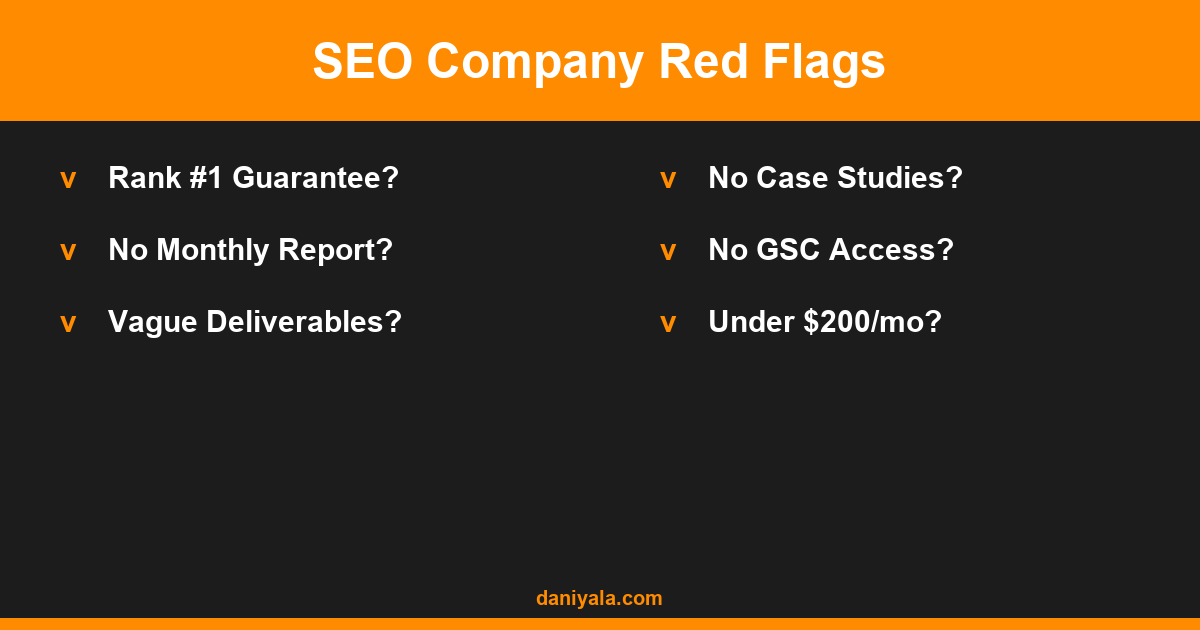
These are non-negotiables — walk away if you encounter any of them:
- Guaranteed first-page rankings — No reputable SEO professional guarantees specific ranking positions. Google’s algorithm isn’t controllable. Anyone making this promise is either uninformed or lying.
- No access to your own GSC/Analytics — You should always own your data. An agency that won’t grant you admin access to your own Search Console account is a serious red flag.
- Pricing under $150/month — Real SEO work takes time. Anything priced under roughly $150/month is either fully automated (low-quality link farms) or so scoped as to be nearly meaningless.
- No written deliverables — A contract that says “SEO services — $500/month” with no specifics is a blank cheque. Require itemised deliverables.
- Secret sauce claims — Any provider who refuses to explain their strategy in broad terms (because it’s “proprietary”) is hiding something. Effective SEO is not a mystery — it’s documented by Google themselves.
- Backlinks from private blog networks (PBNs) — Ask directly. PBN links are a manual action risk. If a provider uses them, they’re building your rankings on a foundation that Google regularly demolishes.
How to Evaluate Proposals Side-by-Side
Once you’ve shortlisted two or three options, compare them on these dimensions:
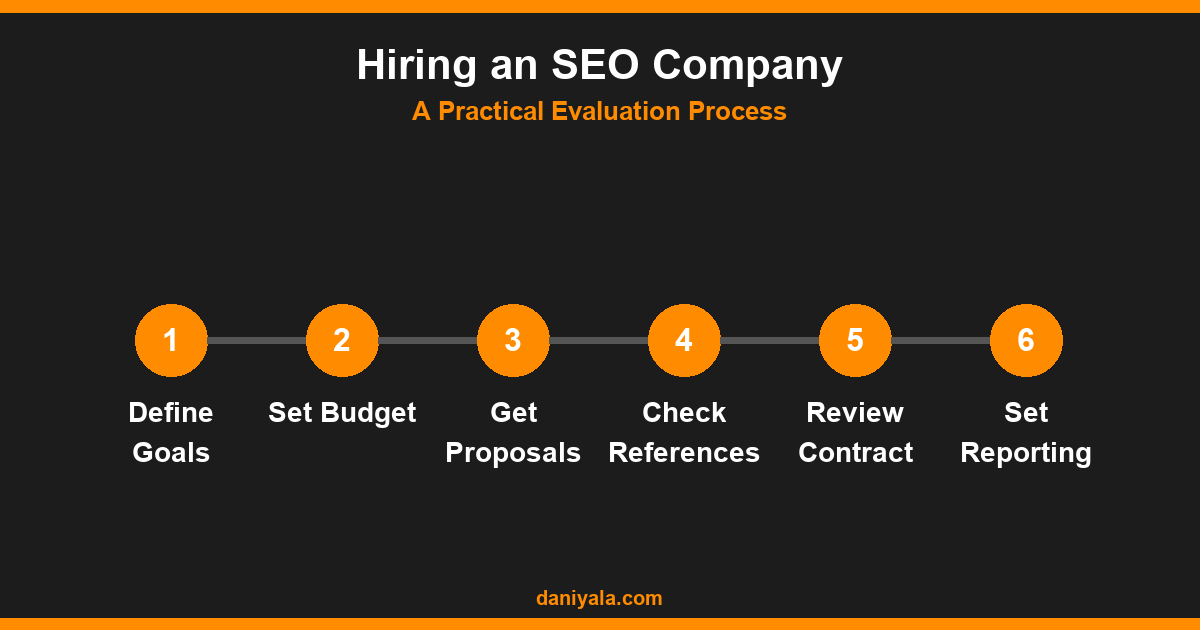
- Discovery process — Did they ask about your business goals, current rankings, and competitors before quoting? A proposal with no discovery phase is templated.
- First 90-day plan — What specifically gets done in month one, month two, month three? Generic plans (“improve on-page SEO, build links”) don’t count as specifics.
- Reporting cadence and format — Monthly report minimum. Insist on seeing a sample report from an existing client account (anonymised is fine).
- Communication access — Will you have a direct contact? How quickly do they respond? Test this during the proposal phase — slow responses before you’re a client don’t improve after.
- Exit terms — How much notice do you need to give? Are there lock-in penalties? 30-day notice is standard; anything longer warrants scrutiny.
Questions to Ask Before You Hire
Use these in any sales call or email exchange:
- “Can you show me a case study from a business similar to mine — same size and industry?” (Specific examples only, not general capability claims)
- “Who specifically will work on my account, and what’s their background?” (Don’t accept “the team”)
- “What do you need from me each month for the work to succeed?”
- “What would cause you to recommend pausing or stopping the engagement?”
- “What results should I realistically expect in the first 6 months for a site with this much competition?” (A professional will give you a calibrated range, not a guarantee)
For reference on what realistic results look like across different small business budgets, see my guide on small business SEO services which covers typical timelines and traffic expectations by budget range. For a complete technical checklist to run before engaging any provider, see my technical SEO audit guide.
Finally, get at least three references from the agency’s current or past clients and actually call them. A 20-minute conversation with a former client will tell you more than any proposal document. Ask what they got for their money and whether they’d hire the provider again.
Frequently Asked Questions
How much should a small business pay for SEO?
For a small local business, a realistic budget is $500–$1,500/month for a competent freelance SEO specialist, or $1,500–$3,000/month for a boutique agency. Below $300/month, the work is typically too thin to move rankings meaningfully. Above $3,000/month makes sense when competition is high and your business has the revenue to justify it.
How long before I see SEO results?
For a site with existing content and no major technical issues, ranking improvements typically show up between months 3 and 6. Competitive keywords in high-intent verticals can take 9–12 months. If a provider tells you results will be visible in 30 days, treat that as a red flag unless they’re referring to a very specific local ranking for an extremely low-competition term.
Should I hire a local SEO company or work with someone remote?
For local SEO — ranking in your city or region — proximity doesn’t determine quality. A remote freelance SEO specialist who understands local ranking signals (Google Business Profile, local citations, proximity indicators) will outperform a nearby agency that runs templated campaigns. Focus on expertise and track record, not geography.
What’s the difference between an SEO company and a freelance SEO consultant?
A company employs multiple people and can execute work across technical, content, and link building simultaneously. A freelancer is typically one person managing the full scope, often with specialist subcontractors for content or outreach. For most small businesses, a skilled individual freelancer delivers better value at smaller budgets. Agencies add value when scope, speed, and team redundancy matter.
What should an SEO contract include?
At minimum: a list of specific monthly deliverables (technical fixes, content pieces, link targets), a reporting schedule, GSC and Analytics access terms, contract length, and notice period for cancellation. Any contract that describes deliverables only as “ongoing SEO optimisation” is too vague to enforce or evaluate.
Need help with your SEO? I’m Daniyal — freelance SEO & WordPress expert working with small businesses globally. Contact me or find me on Upwork.














 by Daniyal © 2026 All Rights Reserved