
If there is one digital marketing channel that clients consistently underestimate, it is email marketing. When someone asks me “what is email marketing exactly?”, my answer is this: it is the practice of sending targeted, permission-based messages to a list of subscribers to build relationships, nurture leads, and drive sales — and it delivers better ROI than almost every other channel available to small businesses. This guide walks through exactly how it works, the different campaign types that matter, which metrics to track, and how to start building a list that generates real revenue.
What Is Email Marketing?
Email marketing is a direct digital marketing channel where businesses send commercial or informational messages to a curated list of opted-in email subscribers. Unlike paid ads that interrupt people mid-browse, email reaches an audience that has explicitly said “yes, I want to hear from you.” That permission-based foundation is what makes it disproportionately effective — you are marketing to warm contacts, not cold strangers.
Email marketing sits within a broader digital strategy. While SEO marketing drives traffic to your website from search engines, email captures that traffic into a list you own outright — completely independent of algorithm changes or platform shutdowns. If Google changes its algorithm tomorrow, your email list still works. That ownership is strategically valuable in a way that rented audiences on social platforms are not.
The mechanics have evolved dramatically. Modern email marketing platforms handle automated list segmentation, A/B testing, triggered sequences based on user behavior, and detailed analytics showing exactly who opened, clicked, and converted. What most businesses are running today — monthly newsletters — is the basement floor of what the channel can do.
How Email Marketing Works
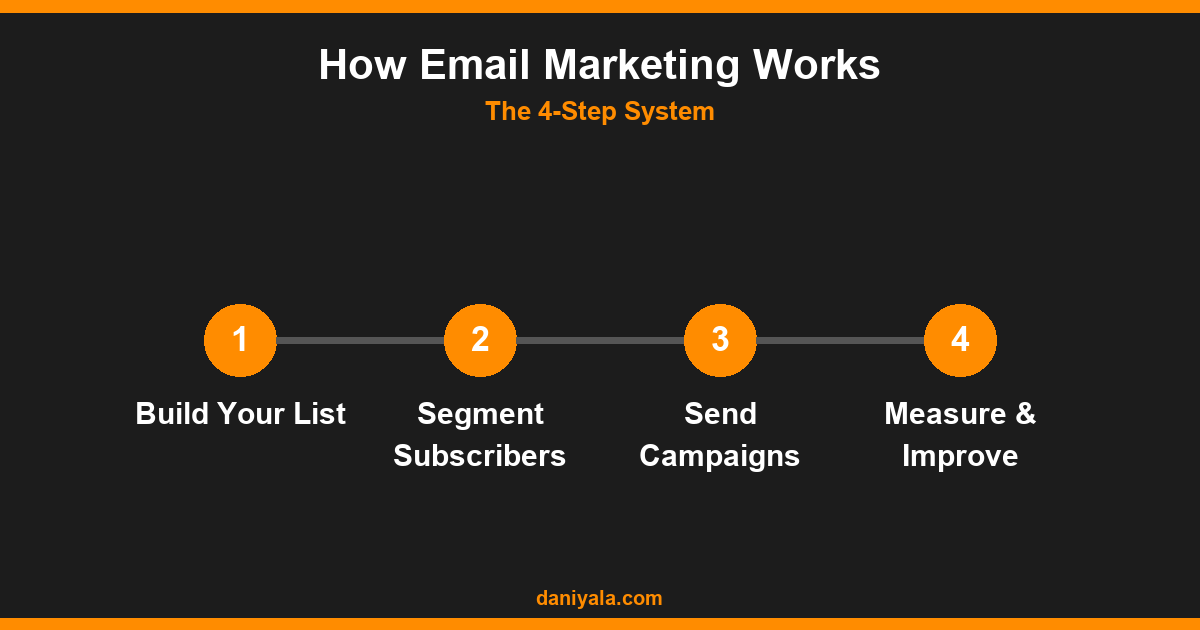
The mechanics break down into four components that function as a system:
- List building: Subscribers join through a signup form, a lead magnet (free guide, checklist, discount code), or a checkout opt-in. Every subscriber has given explicit consent — a legal requirement under GDPR, CAN-SPAM, and CASL regulations in most markets.
- Segmentation: Not all subscribers are equal. Platforms let you segment by behavior (opened last 3 emails, clicked a specific product link), lifecycle stage (new subscriber vs. repeat customer), or demographic. Segmented emails consistently outperform broadcast-to-all emails in every engagement metric.
- Sending via an Email Service Provider: ESPs like Mailchimp, ConvertKit, MailPoet, or ActiveCampaign handle delivery infrastructure, spam compliance, and tracking. For WordPress sites, MailPoet integrates directly into the WP admin dashboard and is a strong starting point for site owners who want to manage email and content in one place.
- Automation and measurement: Once sequences are built — welcome series, abandoned cart recovery, post-purchase follow-up — they run automatically. You measure performance through open rates, click rates, conversion rates, and unsubscribes, then iterate on what underperforms. The analytics loop is what separates email from broadcast advertising: every send teaches you something.
Deliverability is a dimension most beginners overlook. An email that lands in spam generates zero ROI regardless of how well it is written. Google’s Postmaster Tools gives senders direct visibility into their domain reputation with Gmail — one of the most important signals to monitor as your list scales past a few thousand subscribers.
Types of Email Marketing Campaigns
Understanding the distinct campaign types prevents the most common mistake I see: businesses that send weekly newsletters but never set up the automated sequences that actually drive conversions.
Welcome Sequences
Sent automatically when someone subscribes, a well-written 3–5 email welcome series introduces your brand, sets expectations, delivers the lead magnet if applicable, and makes the first soft offer. In every client account I have set up, welcome sequences generate more revenue per subscriber than any other campaign type — primarily because subscribers are most engaged in the first 72 hours after opting in.
Newsletters
Regularly scheduled emails (weekly, bi-weekly, monthly) that maintain relationship with your list. Good newsletters share original insight, curated resources, or behind-the-scenes content. The mistake most businesses make is treating newsletters as a broadcast of their latest blog posts rather than a genuine communication to people they respect.
Promotional Campaigns
Sales announcements, limited-time offers, and product launches. These should make up a minority of total email volume — audiences disengage when every email is a pitch. A sustainable ratio I recommend to clients: roughly 80% value-focused emails for every 20% promotional. Flip that ratio and watch your unsubscribe rate climb.
Behavioral and Triggered Emails
Sent based on specific subscriber actions: abandoned cart emails (someone added to cart but did not purchase), re-engagement campaigns for subscribers inactive for 90 days, and post-purchase sequences that reduce refund rates and drive repeat purchases. These are fully automated and generate revenue around the clock. See the detailed email automation guide for the exact sequences and setup process for WordPress WooCommerce stores.
Transactional Emails
Order confirmations, password resets, shipping notifications. These are high-open-rate touchpoints that most businesses treat as purely functional. Embedding a review request, a relevant upsell, or a referral ask into a transactional email costs nothing extra and consistently produces results because the subscriber is already engaged and expecting the email.
Why Email Marketing Delivers Exceptional ROI
The economics that make email marketing work for small businesses:
- No pay-per-reach model: Unlike paid ads where you pay every time your message appears, email has a flat monthly platform cost regardless of send frequency. Sending to 5,000 subscribers 4 times per month costs the same as sending once.
- Owned audience: Your list is yours. Instagram could change its algorithm, Google could drop your rankings — but the export of subscriber emails you have built remains a business asset with real, transferable value.
- High purchase intent: Subscribers who opted in to hear about your product or service are further down the decision funnel than cold social media followers. They chose to hear from you.
- Measurable and iteratable: Every email campaign produces clear performance data. You improve every send cycle rather than guessing what a billboard or radio ad accomplished.
Key Email Marketing Metrics to Track
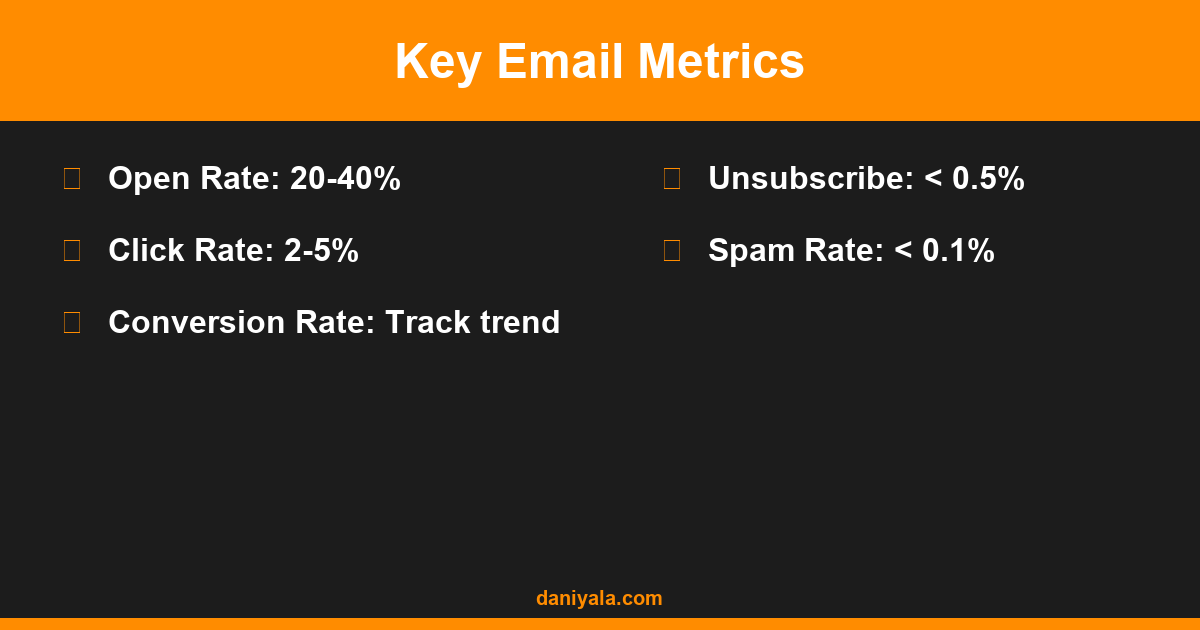
Knowing what to measure prevents vanity metrics from masking real performance problems:
| Metric | What It Measures | Healthy Benchmark |
|---|---|---|
| Open Rate | % of delivered emails opened | 20–40% for engaged lists |
| Click Rate | % of opens that clicked a link | 2–5% for broadcasts |
| Conversion Rate | % of clickers completing desired action | Varies by offer; track the trend |
| Unsubscribe Rate | % opting out per send | Under 0.5% per send |
| Bounce Rate | % not delivered (invalid addresses) | Under 2%; high bounces hurt deliverability |
| Spam Complaint Rate | % marked as spam | Under 0.1% — this is critical |
One nuance on open rate: since Apple’s Mail Privacy Protection launched in 2021, open rates are increasingly inflated because Apple prefetches emails and registers opens even when the subscriber never actually reads the email. For lists with significant Apple Mail users, click rate and conversion rate are more reliable engagement signals than raw open rate.
How to Start Email Marketing Step by Step
The practical launch sequence for a small business starting from zero:
- Choose an ESP: For WordPress sites under 1,000 subscribers, MailPoet’s free plan is an excellent starting point — it lives inside your WP admin, integrates with WooCommerce, and handles basic automation. For more advanced segmentation from day one, ConvertKit or ActiveCampaign are worth the investment. The comprehensive email marketing guide covers a full ESP comparison with pricing tiers and ideal use cases.
- Create a lead magnet: A free PDF guide, checklist, or template that provides immediate value in exchange for an email address. The lead magnet must be directly relevant to your core service — the subscriber who opts in for a “WordPress Speed Checklist” is pre-qualified as someone who cares about website performance, which makes them far more likely to convert into a client later.
- Set up double opt-in: Require subscribers to confirm their address after signing up. This reduces spam complaints, keeps your list clean, and satisfies GDPR requirements in European markets.
- Write a 3-email welcome sequence: Email 1 delivers the lead magnet and introduces you as a person. Email 2 (2 days later) shares your most useful free content. Email 3 (4 days after that) makes a soft introduction to your service. This alone outperforms what most small businesses ever build.
- Plan a consistent sending schedule: Weekly or bi-weekly works for most service businesses. Consistency matters for deliverability and subscriber expectation-setting. Erratic sending trains ISPs to treat your emails as anomalies — which negatively affects inbox placement.
Frequently Asked Questions
What is email marketing used for?
Email marketing is used to build and maintain relationships with subscribers, nurture leads through the decision-making process, drive direct sales and repeat purchases, and retain existing customers. It is equally useful for e-commerce businesses sending promotional campaigns as it is for service businesses using educational newsletters to position themselves as trusted experts in their field.
Is email marketing still effective in 2026?
Yes — and for a specific reason: it is the only major digital marketing channel where you fully own the audience. Social platforms restrict organic reach and search rankings shift with algorithm updates, but your email list is a compounding asset. A targeted list of 2,000 engaged subscribers consistently outperforms 20,000 social media followers in conversion metrics for most small businesses.
How often should I send marketing emails?
For most small businesses, a weekly or bi-weekly cadence strikes the right balance between staying top of mind and respecting inboxes. Monitor your unsubscribe rate per send — a sustained rate above 0.5% usually signals frequency problems or relevance issues that need to be addressed before continuing to scale send volume.
What makes a good marketing email?
A clear subject line that accurately reflects the email’s content, a single focused call to action rather than multiple competing ones, copy written for the reader’s benefit rather than self-promotion, and a mobile-optimized layout. Personalization and list segmentation consistently improve performance over generic broadcast emails — even simple segmentation by engagement level makes a measurable difference.
Do I need a big budget for email marketing?
No. Most ESPs have free tiers that support 500–2,000 subscribers, which is more than enough to build real traction as a small business. The primary investment is time — writing quality emails, building automation sequences, and crafting a lead magnet that attracts the right subscribers. The infrastructure cost is minimal compared to paid advertising at comparable reach.
What is the difference between email marketing and email automation?
Email marketing is the broader practice of using email as a marketing channel — newsletters, promotions, and broadcasts sent on a schedule. Email automation is a subset: pre-written sequences that trigger automatically based on subscriber actions like a new signup, a product purchase, or cart abandonment. The highest-performing email programs combine both: regular newsletters keep the list warm while automation handles the high-conversion sequences running 24/7 in the background.
Need help setting up email marketing or automation for your business? I’m Daniyal — freelance SEO & WordPress expert. Contact me or find me on Upwork.













 by Daniyal © 2026 All Rights Reserved