
One of the most common questions I get from business owners is: how much should SEO actually cost? SEO services pricing is genuinely confusing because rates vary from $100 a month to $10,000 a month — and both can be legitimate depending on what’s included. Having hired and evaluated SEO providers as well as delivered SEO services myself, I can tell you exactly what drives these price differences and how to tell a fair quote from an overpriced one.
This guide covers the main pricing models, realistic ranges by business size, and the red flags that indicate you’re being overcharged — or underpromised to.
Table of Contents
What Does SEO Typically Cost in 2026?
Across the industry, SEO services pricing broadly falls into these ranges:
| Business Type | Typical Monthly Cost | What’s Included |
|---|---|---|
| Small local business | $300 – $800/mo | GBP optimisation, local citations, basic on-page |
| SME / regional business | $800 – $2,500/mo | Full on-page, content, technical audits, link building |
| E-commerce / competitive niche | $2,500 – $6,000/mo | Technical SEO, content strategy, digital PR, analytics |
| Enterprise / national | $6,000 – $25,000+/mo | Dedicated team, CRO, international SEO, custom reporting |
These are not precise; they’re the ranges I’ve seen across proposals from vetted providers. Your actual cost depends on competition, site condition, location, and the scope of work — all factors I’ll cover below.
SEO Pricing Models Explained
Monthly Retainer
The most common SEO pricing model. You pay a fixed monthly fee for an ongoing scope: technical maintenance, content creation, link building, and reporting. Retainers work well when SEO is part of a long-term strategy — which it almost always should be, given that organic rankings take time to build.
The advantage is predictability. You know what you’re spending and what’s covered each month. The risk is that some providers pad hours with low-value activity. Ask for a monthly deliverable list: what specific tasks are completed, what metrics are tracked, and how results are reported.
Hourly Rate
Experienced SEO consultants typically charge $75–$200/hour. This model suits one-off projects: an audit, a site migration review, or a penalty assessment. It’s less suitable for ongoing work because hours can drift and costs become unpredictable.
Hourly work is best scoped with a fixed hour budget upfront — for example, a 10-hour technical audit at $100/hour = $1,000 flat. For reference, a thorough technical SEO review covers many of the same areas as my technical SEO audit guide, which should give you a sense of what that kind of work involves.
Project-Based Pricing
Some providers price specific deliverables: a content strategy document, a full technical audit report, or a backlink acquisition campaign. This suits businesses that know exactly what they need and want cost certainty.
Common project prices:
- Technical SEO audit: $500 – $3,000 depending on site size
- Keyword research and content strategy: $500 – $2,000
- Site migration support: $1,500 – $8,000
- One-off link building campaign: $500 – $5,000
What Factors Affect SEO Services Pricing?
Two businesses in the same city with the same monthly budget will get very different outcomes depending on these variables:
Competitiveness of keywords. Ranking a plumber in a small town requires less effort than ranking a law firm in a major city. The more competitive the search landscape, the more time (and cost) is required to move the needle. This is one reason a generic “SEO package” price is meaningless without knowing your specific niche and location.
Current site condition. A site with severe technical issues — crawl errors, duplicate content, thin pages, slow load times — requires remediation work before link building or content investment makes sense. The upfront cost is higher, but addressing technical foundations first is the right order of operations. For small businesses specifically, see what an effective strategy looks like in my SEO for small business guide.
Content requirements. Sites in information-dense niches (legal, medical, finance, SaaS) need well-researched, expert-level content to rank. That content costs more to produce correctly than general lifestyle content.
Link building scope. Acquiring authoritative backlinks — a key ranking signal — is time-intensive and varies in cost based on your industry. A local service business might need 5–10 quality local citations per month; a national brand targeting competitive commercial keywords might need editorial placements from industry publications.
Reporting and communication. Some agencies include detailed monthly reports, strategy calls, and real-time dashboards. Others send a basic PDF. The level of transparency and communication affects both the service quality and the price.
SEO Package Tiers and What You Actually Get
Most agencies offer tiered packages. Here’s what realistic tiers look like — and what to question:
Basic / Starter ($300–$600/mo): Suitable for new local businesses. Typically covers Google Business Profile optimisation, on-page meta tags for key pages, basic citation building, and a monthly report. Does not usually include link building or content creation. Good as a foundation, not sufficient for competitive niches.
Growth ($700–$1,500/mo): Adds content creation (2–4 blog posts/month), some link building, and technical monitoring. Most established small businesses should be in this range. Ask what happens to the content strategy if you cancel — you should own all content and retain your rankings trajectory.
Aggressive / Competitive ($2,000+/mo): Includes a content calendar, proactive link acquisition, technical sprint cycles, and conversion tracking. Appropriate for e-commerce sites, SaaS businesses, or local businesses competing in dense metro markets.
For a broader breakdown of how these costs compare across the industry, my full SEO pricing guide covers what each tier typically delivers in measurable outcomes.
Red Flags in SEO Pricing
Cheap SEO that damages your site can cost you far more in recovery time than the money you saved. These are the warning signs:
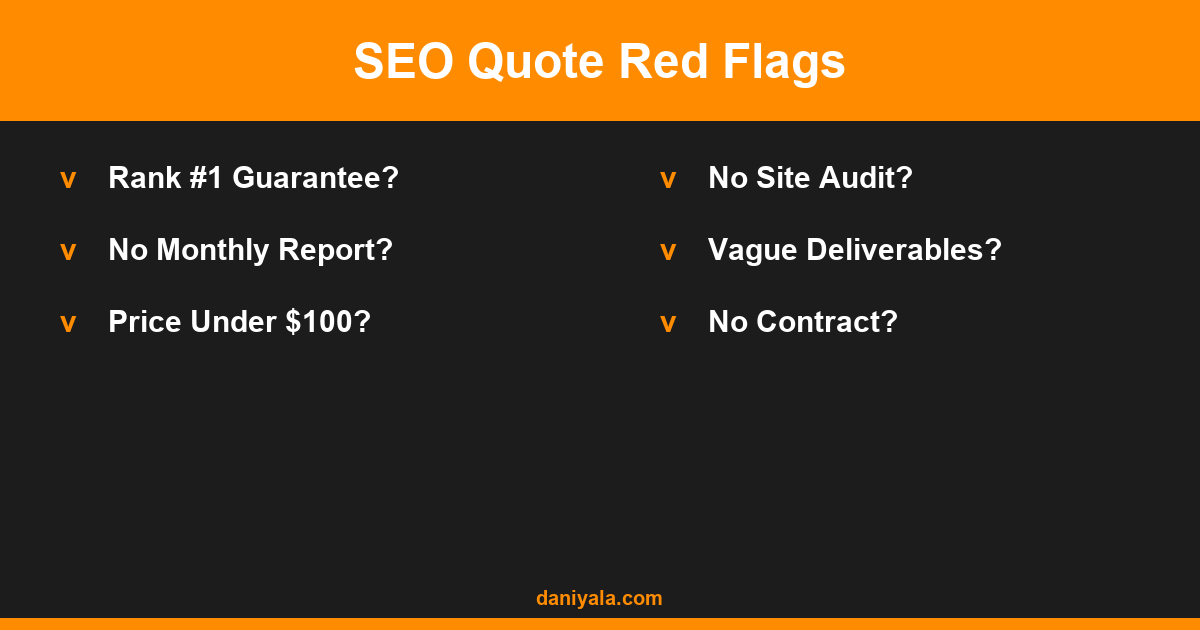
- Guaranteed #1 rankings. No legitimate SEO provider guarantees a specific rank. Google’s algorithms are proprietary; rankings depend on competition, user behaviour, and countless signals no one outside Google controls.
- No reporting or transparency. If a provider can’t show you what they’re doing and what results it’s producing, you’re paying blind.
- Extremely low prices ($49–$99/mo). At these price points, the provider is either using automated link spam, buying links from low-quality networks, or doing nothing meaningful. Both of the first two can result in manual penalties from Google.
- No contract or scope document. A professional provider will document what they deliver each month. Vague agreements lead to vague results and make it impossible to evaluate performance.
- Link building from private blog networks (PBNs). PBN links are against Google’s guidelines and regularly devalued in algorithm updates. Ask specifically where your links will come from. Google’s official SEO Starter Guide explains what legitimate optimisation looks like.
If you want to understand more about what legitimate SEO services for small businesses actually include, that guide covers the realistic deliverables for each budget tier.
How to Evaluate an SEO Quote
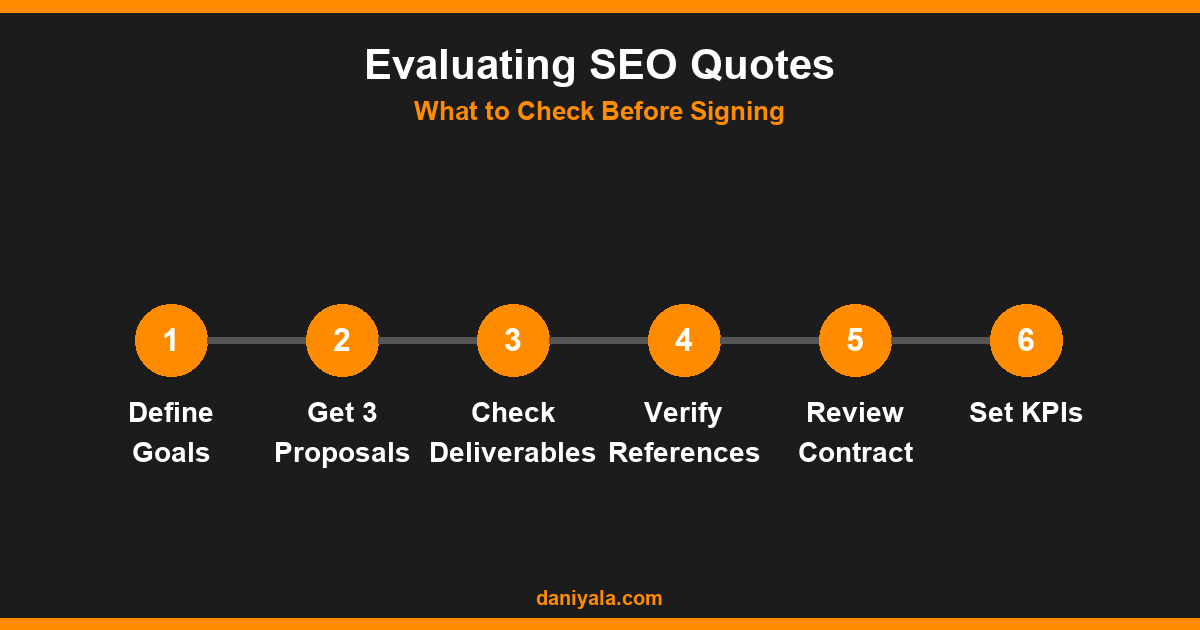
When you receive a proposal, ask these questions before signing:
- What specific tasks are included in the monthly scope?
- How many hours per month does this represent?
- What metrics will you report on, and how often?
- What does the first 90 days look like (audit, strategy, execution)?
- Can I see examples of results from similar businesses?
- What happens to the content and links if I stop working with you?
A provider who answers these clearly and specifically — without evasion — is worth engaging. One who responds with vague promises or refuses to commit to deliverables in writing is not. For a wider breakdown of costs across different service models, see my guide on how much SEO services cost.
Is Cheap SEO Ever Worth It?
There is a middle ground. Competent freelancers in lower-cost markets (Pakistan, Eastern Europe, Southeast Asia) often deliver strong technical and on-page SEO at $300–$500/month. The key is vetting their work quality, not just their price.
Ask for a sample audit, a portfolio of measurable results (screenshot of GSC showing ranking improvements), and references from past clients. A skilled freelancer with a $350/month retainer can outperform a $1,200/month agency if the agency’s work is templated and shallow.
The best benchmark is results: organic traffic growth, keyword movement in Google Search Console, and lead volume from organic. These are the numbers that matter, regardless of what you paid to get them. You can track these easily using the tools described in Google Search Console — it’s free and shows you exactly where your traffic comes from.
Frequently Asked Questions
Why does SEO pricing vary so much between providers?
SEO pricing varies because the scope, quality, and approach differ enormously. A $200/month package from a reseller using templated work is not comparable to a $2,000/month retainer from an experienced consultant running a custom strategy. Deliverables, experience level, tools, and the competitiveness of your niche all drive the range. Always compare detailed scopes rather than prices alone.
How long before I see results from SEO investment?
Realistic timelines for SEO results: 3–6 months for initial movement on low-competition keywords, 6–12 months for meaningful traffic increases on competitive terms. Factors that speed this up include a technically clean site, an existing domain with some authority, and content that matches search intent precisely. New domains typically need 6–9 months before significant organic traffic appears.
Should I pay for SEO or run Google Ads instead?
Both serve different purposes. Google Ads deliver immediate traffic with a direct cost per click. SEO builds an organic traffic asset that compounds over time. For businesses with short-term cash flow needs, Ads make more sense initially. For businesses investing in 12+ month growth, SEO typically delivers better cost-per-lead over time. Many established businesses run both in parallel for different parts of the funnel.
What is included in a basic SEO audit?
A basic SEO audit covers: crawl health (broken links, redirect chains, duplicate content), page speed and Core Web Vitals, meta tag completeness, keyword targeting on key pages, internal linking structure, and a backlink profile overview. A thorough audit also checks structured data, canonicals, mobile usability, and Google Search Console error reports. Expect to pay $500–$2,000 for a site audit from a competent provider.
Can I do SEO myself instead of hiring someone?
Yes, but it requires time and consistent effort. DIY SEO is realistic for small local businesses with straightforward competition. The fundamentals — claiming your Google Business Profile, writing optimised content, fixing technical issues — can be learned and implemented without a specialist. Where hiring helps most is in link building, technical auditing, and competitive strategy for saturated markets.
Trying to figure out a fair budget for SEO? I’m Daniyal — freelance SEO & WordPress expert. I can audit your site and give you an honest scope. Contact me or find me on Upwork.












 by Daniyal © 2026 All Rights Reserved