

The most common question I get from potential clients before any discovery call is: how much does seo services cost? The honest answer is that pricing varies enormously — from a few hundred dollars per month for local SEO from a freelancer to tens of thousands per month for enterprise-level agency retainers. But “it varies” is not a useful answer. This guide gives you real pricing ranges segmented by service type, explains what actually drives the price up or down, and helps you identify whether a quote you have received is reasonable or a red flag.
How Much Do SEO Services Cost? The Quick Answer
Here are the broad ranges you will encounter in 2026:
| Service Type | Typical Price Range | Who It Suits |
|---|---|---|
| Freelancer monthly retainer | $300 – $1,500/month | Small businesses, local services |
| Small agency monthly retainer | $1,000 – $5,000/month | Growing SMBs, e-commerce |
| Mid-size to large agency | $5,000 – $20,000+/month | National brands, enterprise sites |
| One-time SEO audit | $500 – $3,000 | Any business needing a clear diagnosis |
| Local SEO package | $300 – $1,500/month | Local businesses targeting one city/region |
| Hourly consulting | $75 – $250/hour | Specific questions, strategy reviews |
| Content-only SEO writing | $100 – $500 per article | Businesses handling technical SEO in-house |
For a detailed breakdown of what you should expect at each price tier, the full SEO pricing guide covers deliverables, contract structures, and how to evaluate whether a proposal matches market rates for your specific situation.
SEO Pricing Models Explained
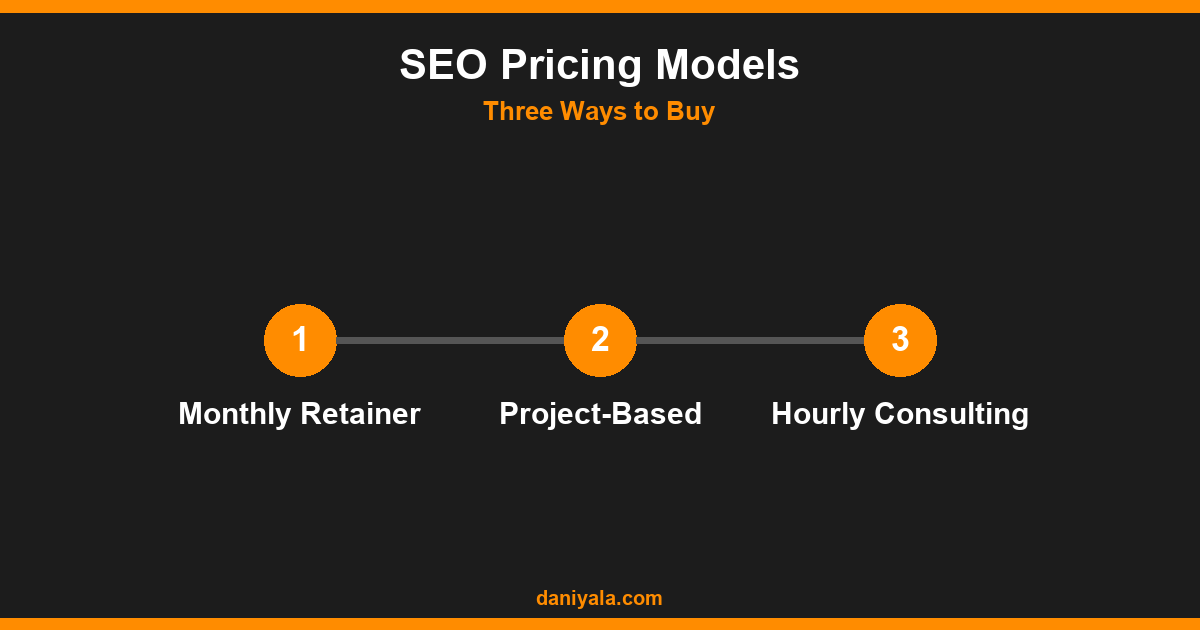
SEO services are typically structured in one of three ways, each with different risk and reward profiles for the client:
Monthly Retainer
The most common model. You pay a fixed monthly fee for an ongoing scope of work — typically including keyword tracking, content production, technical fixes, link building outreach, and monthly reporting. Retainers work well for SEO because the discipline requires sustained, compounding effort: results from month 3 build on month 1 work, and stopping the retainer mid-campaign often forfeits results that were weeks away from materializing. Most established freelancers and agencies price retainers based on the hours required per month multiplied by their hourly rate, plus any hard costs like tools or link placements.
Project-Based Pricing
A fixed fee for a defined deliverable: a technical SEO audit, a site migration plan, a keyword research document, or an on-page optimization pass on 50 pages. Project pricing gives clients budget certainty and works well when the scope is clearly defined and finite. I frequently take on project work for clients who handle ongoing content in-house but need a one-time technical foundation built correctly. A professional technical SEO audit that documents every crawl error, Core Web Vitals issue, and structural problem on your site is one of the highest-ROI single projects you can commission — it tells you exactly what to fix before spending another dollar on content.
Hourly Consulting
Least common for ongoing SEO, most common for strategy consultations, second opinions on proposals, or training sessions for in-house teams. Hourly rates for experienced SEO consultants range from $75 to $250+ depending on the practitioner’s track record and specialization. Be cautious of hourly arrangements for ongoing SEO work — without a defined scope, hourly engagements can run open-ended with unclear ROI accountability.
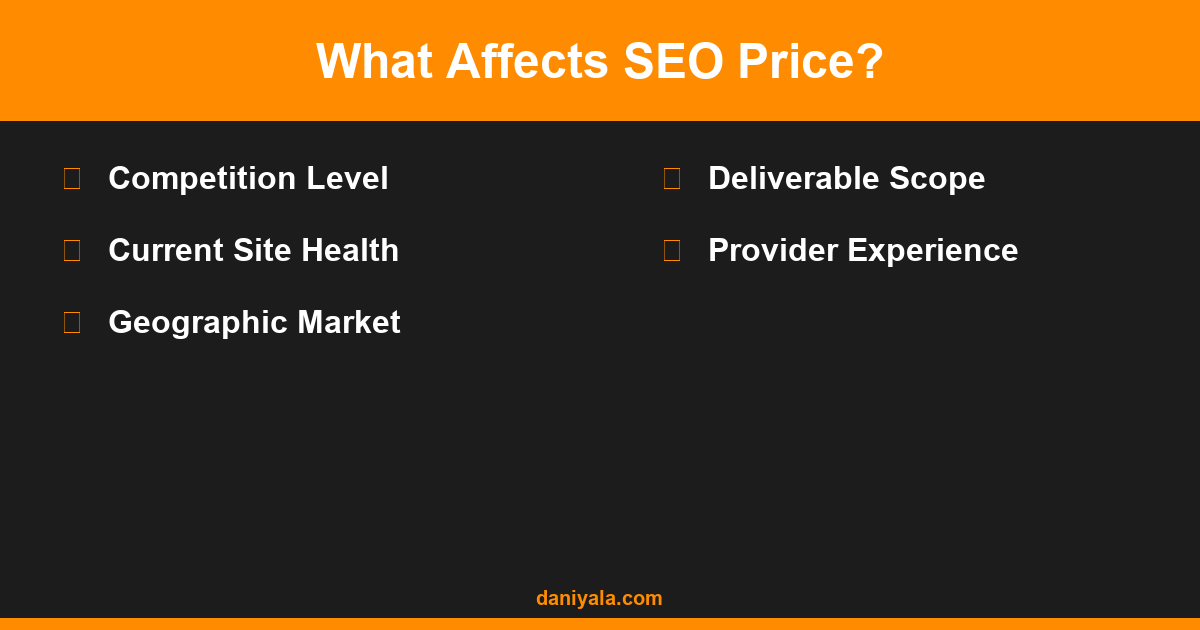
What Affects SEO Service Costs?
Understanding the drivers behind pricing helps you assess whether a quote is appropriate for your situation:
Competition Level in Your Market
Ranking a plumber in a small Pakistani city takes a fundamentally different effort level than ranking an e-commerce store competing against Amazon and Wayfair for furniture keywords nationally. High-competition markets require more content volume, more aggressive link building, and longer timelines — all of which cost more. The keyword research phase of any engagement should establish competition level before scope and pricing are agreed.
Current Site Health
A site with severe technical issues — crawl errors, duplicate content from parameter URLs, slow load times, thin content across hundreds of pages — requires remediation work before any growth strategy can gain traction. Sites in poor technical health are more expensive to service in the early months of an engagement. A site that is technically clean and just needs content and link building is simpler and cheaper to maintain. This is why auditing before signing a retainer is standard practice for professional SEO providers.
Geographic Market and Target Audience
Local SEO targeting one city (e.g., ranking for “plumber in Karachi”) is structurally simpler and less expensive than national or international SEO across broad keyword sets. Local SEO work focuses heavily on Google Business Profile optimization, local citations, locally-relevant content, and review strategy — a narrower scope with more predictable timelines. Google’s Search Central documentation and Search Console are the primary data sources any legitimate SEO provider should be working from — tools that are free and public. If an SEO provider cannot explain their work in terms of Search Console data, that is a process concern.
Deliverables and Reporting Depth
A retainer that includes keyword tracking, monthly performance reporting, technical audits, 4 SEO content pieces, and backlink outreach is more expensive than one that covers content only. Clarifying exactly what deliverables are included — and excluded — before signing any agreement prevents the most common source of client-provider conflict in SEO engagements.
Provider Experience and Track Record
A freelancer with a public portfolio of ranking results and verified client reviews on Upwork charges more than a generalist VA offering “SEO” as one of twenty services. Experience in your specific niche (e-commerce, local services, SaaS) commands a premium. The pricing difference is generally justified — an experienced specialist who knows what works for your site type will generate results faster than a generalist learning your niche on your budget.
Red Flags in SEO Pricing
Several pricing patterns consistently correlate with poor outcomes:
- Guaranteed #1 rankings: No legitimate SEO provider guarantees specific ranking positions — Google explicitly states that no one can guarantee rankings. Any proposal that includes ranking guarantees as a deliverable is either naive or deceptive.
- Very low-cost “packages” under $100/month: Effective SEO requires real time investment — keyword research, content creation, technical fixes, link outreach. Prices this low typically mean automated link spam, spun content, or no real work being done. These tactics can damage a site’s standing in Google for years.
- No reporting or measurement: Professional SEO is measured. Any provider who cannot tell you what keywords you rank for, what pages are getting impressions in Search Console, and what has changed month-over-month is not doing professional SEO work.
- Vague deliverable descriptions: “We do SEO for your site” is not a scope of work. A professional proposal specifies what deliverables are produced, how many hours or content pieces are included, and what tools are used for measurement.
For context on what website projects cost holistically, the website design cost guide gives comparable breakdowns for development and design — useful if you are building or rebuilding a site at the same time you are evaluating SEO investment.
How to Budget for SEO Services
Practical guidance on sizing your budget:
- Start with your business goal: What does a new customer cost you to acquire through other channels? SEO’s value is measured against that baseline. If a paid search lead costs $150, and SEO can generate the same lead quality at $30 over 12 months, the ROI math is straightforward.
- Factor in time to results: SEO typically takes 4–12 months to produce meaningful organic traffic — longer for new domains, shorter for established sites with strong existing authority. Budget accordingly. Signing a 3-month retainer and canceling when results have not yet compounded is the most common way businesses get poor ROI from SEO investment.
- Match scope to goals: If you need 3 new clients per month from SEO, a minimal $300/month local SEO package may get there in 8 months. If you need 100, you need a proportionally larger content and link building program. Scope should follow from conversion targets, not from what seems affordable in isolation.
- Get a technical audit before committing to ongoing work: A one-time audit from a professional before signing a retainer tells you what you are actually dealing with — and lets you compare proposals apples-to-apples based on the same site assessment.
Frequently Asked Questions
How much should a small business pay for SEO?
For local small businesses targeting customers in one city or region, a monthly budget of $500–$1,500 is a realistic starting point for professional SEO from an experienced freelancer. This typically covers keyword research, local citation management, Google Business Profile optimization, one or two content pieces per month, and basic link building. Lower-budget options exist, but at under $300/month you are generally not getting enough hours to move results in competitive markets.
Is paying for SEO worth it?
For businesses where customers search for what they offer online — and that is most businesses — yes, SEO investment typically produces positive ROI when given adequate time and budget to compound. The important caveat is timeline: SEO is not the right channel if you need leads next week. It is the right channel if you want to reduce customer acquisition cost over the next 12–24 months by owning organic search demand that does not disappear when ad spend stops.
Can I do SEO myself instead of paying?
Yes — for low-to-medium-competition local keywords, a business owner who learns the fundamentals can move rankings meaningfully with consistent effort on content, on-page optimization, and basic link building. The cost is time rather than money. The practical limit is that SEO done well requires technical knowledge (crawl analysis, schema markup, Core Web Vitals optimization) that takes significant time to learn properly. Most business owners find hybrid approaches work best: handle content strategy in-house, hire a specialist for technical foundation and link strategy.
Why are some SEO agencies so expensive?
Large agency pricing reflects overhead costs (salaries, office, management layers), team specialization (dedicated technical SEOs, content writers, link builders), and client service infrastructure (account managers, reporting systems). They also carry risk from their guarantees and SLAs. A solo freelancer with lower overhead can deliver comparable results for straightforward projects at a fraction of the cost — the agency premium is justified primarily when you need project scale, multi-team coordination, or enterprise-grade reporting.
What is included in an SEO audit?
A professional SEO audit covers: technical health (crawl errors, indexation issues, site speed, mobile usability, Core Web Vitals), on-page SEO (title tag and meta description quality, heading structure, content gaps), internal link architecture, backlink profile health, keyword ranking baseline, and competitor gap analysis. The output is a prioritized action plan ranked by expected impact. Audit depth and price range from a basic automated report (low value) to a thorough manual analysis (high value) — ask for examples of deliverables before commissioning any audit.
Want an SEO audit or monthly SEO services for your website? I’m Daniyal — freelance SEO & WordPress expert. Contact me or find me on Upwork.














 by Daniyal © 2026 All Rights Reserved