
Of all the marketing channels I recommend to small business clients, email marketing for small business consistently delivers the best return on effort. Not because it’s glamorous — it isn’t — but because email reaches people who already raised their hand and said they’re interested. You’re not paying to interrupt strangers; you’re talking to a warm audience you built. This guide covers how to build that audience and what to do with it once you have it.
Table of Contents
- Why Email Marketing Delivers the Best ROI for Small Businesses
- Building Your Email List from Zero
- Choosing the Right Email Marketing Platform
- Writing Emails That Actually Get Opened and Clicked
- The 5 Email Sequences Every Small Business Needs
- Segmentation: Sending the Right Email to the Right Person
- Email Metrics That Show What’s Working
- Common Email Marketing Mistakes Small Businesses Make
- Frequently Asked Questions
Why Email Marketing Delivers the Best ROI for Small Businesses
The economics of email marketing are hard to argue with. You’re not bidding against competitors for ad space. You’re not at the mercy of a social media algorithm that decides whether your followers see your post. Email lands in an inbox, directly, every time — as long as you’ve earned the right to be there.
For small businesses specifically, email has several advantages over other channels:
- You own the list. Your Instagram followers aren’t yours — the platform is. Your email list is yours regardless of what any platform does.
- Higher purchase intent. Someone who signed up for your emails has already shown interest. That’s fundamentally different from reaching a cold audience.
- Low marginal cost. Sending to 500 subscribers costs roughly the same as sending to 50. Your cost per contact goes down as your list grows.
- Measurable. Open rates, click rates, and conversions are visible and actionable in a way that offline marketing or social reach rarely is.
The catch: email only works if you do it consistently and with genuine value in each send. Sending an email every three months when you want to sell something is not email marketing — it’s spam with good intentions.
Building Your Email List from Zero
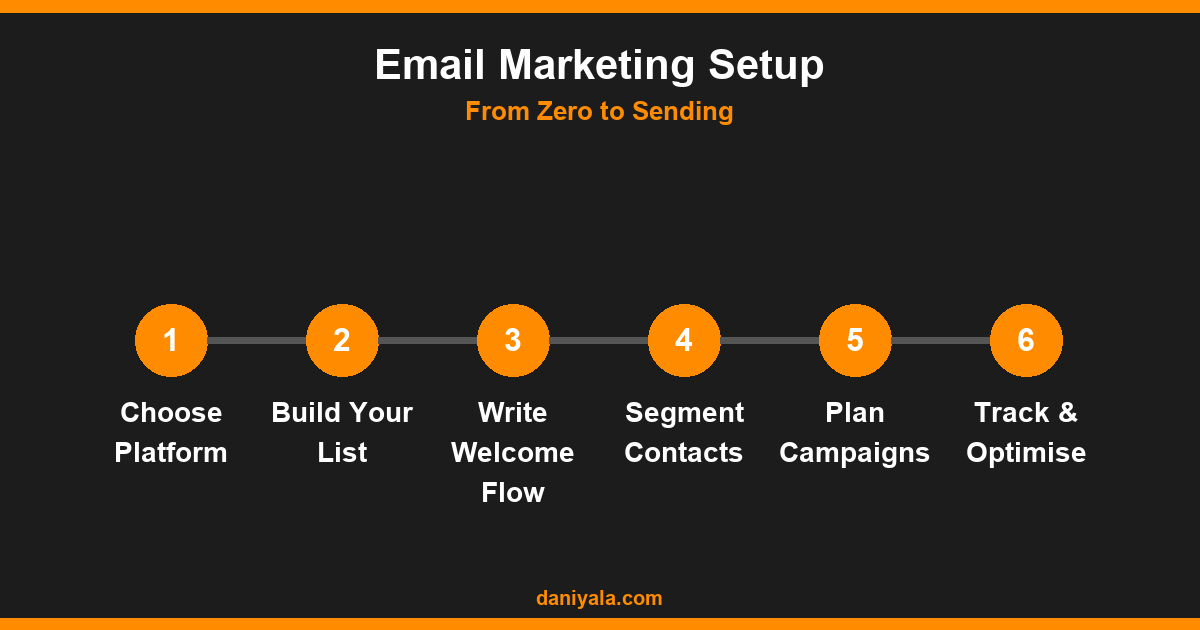
The most common mistake I see small businesses make is waiting until they have “something to say” before building a list. By then, there’s no list to say it to. Start building your list now, even before you know exactly how you’ll use it.
Practical list-building approaches for small businesses:
Lead magnets that are genuinely useful. A PDF checklist, a short guide, a free consultation, a discount code — something with real value that makes the trade (email address for resource) feel fair. The more specific the offer, the higher the conversion rate. “Free guide to cutting your electricity bill in summer” converts better than “Sign up for our newsletter.”
Opt-in forms in the right places. On your website: homepage, about page, blog sidebar, and pop-up triggered after 30–60 seconds (not immediately, which irritates people). At physical touchpoints: a sign-up iPad at the counter, a business card with a QR code linking to the sign-up form.
Social media traffic to a landing page. Send Instagram or Facebook followers to a dedicated page with a compelling reason to subscribe. Don’t just say “sign up for emails” — explain what they’ll get and how often.
Events and consultations. If you run workshops, consultations, or any in-person touchpoints, ask for an email address as part of the process. Be transparent about how you’ll use it.
The quality of your list matters more than the size. 300 genuinely interested subscribers outperform 3,000 people who vaguely remember signing up for something. Read my full email marketing guide for a deeper dive on list health and segmentation principles.
Choosing the Right Email Marketing Platform
The platform you choose affects your deliverability, automation capabilities, and how much time email management takes. For small businesses, I typically recommend one of these:
| Platform | Best For | Free Tier | Starting Price |
|---|---|---|---|
| Mailchimp | Beginners, simple campaigns | 500 contacts, 1,000 sends/mo | ~$13/mo for growth features |
| MailerLite | Budget-conscious, clean UI | 1,000 contacts, 12,000 sends/mo | ~$9/mo for automation |
| FluentCRM | WordPress-based businesses | Requires WordPress hosting | $129/yr flat (unlimited contacts) |
| ActiveCampaign | Advanced automation | No | ~$29/mo |
| ConvertKit (Kit) | Content creators, course sellers | 1,000 contacts | ~$25/mo |
If your website runs on WordPress, FluentCRM is worth serious consideration — it runs entirely within your WordPress site, integrates natively with WooCommerce and contact forms, and charges a flat annual fee rather than per-contact pricing that scales against you as your list grows. For a detailed automation walkthrough, see my email automation guide.
Writing Emails That Actually Get Opened and Clicked
The open rate is won or lost in the subject line. The click is won or lost in the body. Both are craft skills you get better at with practice and testing.
Subject line principles:
- Shorter is almost always better — aim for under 50 characters
- Curiosity and specificity both work; vague “newsletter” subjects don’t
- Avoid spammy capitalisations (FREE!!), excessive punctuation, and words that trigger spam filters (act now, limited time, click here)
- Test at least two subject lines if your platform supports A/B testing
Email body principles:
- Get to the point in the first sentence. Assume readers are scanning, not reading.
- One email, one primary action. Multiple CTAs compete with each other.
- Write like a person, not a brand. Use “I” and “you,” not “we” and “our valued customers.”
- Keep it short — 150–300 words for most campaign emails. Long emails work for newsletters where people expect depth.
- Plain text emails often outperform heavily designed ones for personal service businesses. Test both.
The 5 Email Sequences Every Small Business Needs
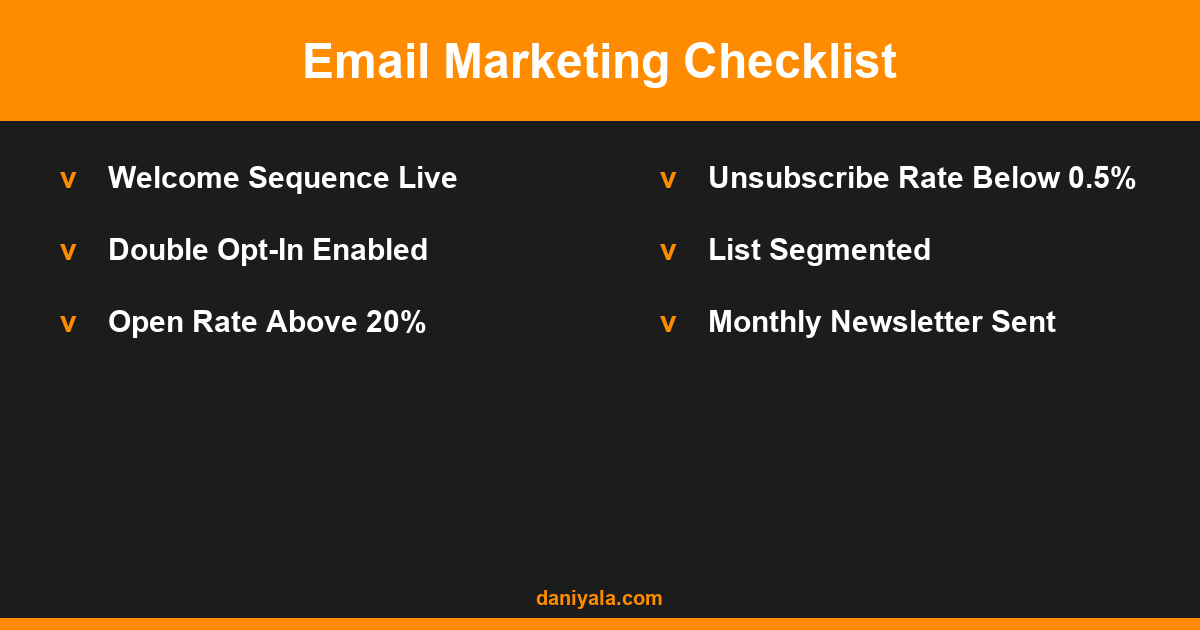
Automated email sequences run in the background without you having to manually send anything after the initial setup. These are the five I set up for every small business client:
1. Welcome sequence (3–5 emails over 7–10 days). Sent to everyone who joins your list. Introduce yourself, deliver your lead magnet, share your story and why you do what you do, explain what to expect from your emails, and make a soft offer. This is your highest-engagement window.
2. New customer onboarding sequence. Triggered when someone makes a first purchase or books a first appointment. Confirms their decision was right, tells them what to expect, gives them useful resources, and reduces buyer’s remorse. Significantly reduces refund rates and cancellation requests.
3. Re-engagement sequence. Triggered when a subscriber hasn’t opened an email in 90 days. 2–3 emails asking if they still want to hear from you. Those who don’t respond get removed — a smaller, engaged list outperforms a large disengaged one on deliverability alone.
4. Post-purchase follow-up. Sent 7–14 days after a purchase. Ask for a review or testimonial, offer a related product or service, invite them to refer someone.
5. Abandoned enquiry or cart. For service businesses, this is triggered when someone fills in a contact form but doesn’t follow through. For ecommerce, it’s an abandoned cart. A simple follow-up 24 hours later recovers a meaningful percentage of these.
The basics of what email marketing covers ties these sequences into the broader strategy context if you want more detail on the fundamentals.
Segmentation: Sending the Right Email to the Right Person
Segmentation means dividing your list into groups and sending different content to each group. The simplest and most impactful segmentation for small businesses:
- Customers vs. prospects — people who’ve paid you and people who haven’t need completely different messages
- Service interest — if you offer multiple services, segment by what they enquired about or bought
- Engagement level — active openers vs. inactive subscribers (treat them differently or clean the inactive ones regularly)
- Location — if you’re local, segmenting by city or region lets you send relevant offers (seasonal promotions, local events)
You don’t need to build every segment on day one. Start with customers vs. prospects. That single distinction will immediately improve your results because you stop sending the same “here’s what we offer” email to someone who already bought from you last month.
Email Metrics That Show What’s Working
Focus on these four metrics and ignore everything else until you’ve mastered them:
- Open rate — benchmark 20–30% for small businesses. Below 15% usually means deliverability issues or a disengaged list.
- Click-through rate (CTR) — benchmark 2–5% of total sends. If your open rate is good but CTR is low, the email body or CTA needs work.
- Unsubscribe rate — below 0.5% per send is healthy. Above 1% consistently means you’re either sending too often or the content isn’t matching what subscribers expected.
- Conversion rate — the percentage who took the action you wanted (booked, bought, enquired). This is the only metric that ultimately matters for revenue.
Track these monthly and look for trends rather than reacting to any single send. One low open rate might be a bad subject line. Five consecutive low open rates is a systemic problem worth investigating.
Common Email Marketing Mistakes Small Businesses Make
These are the patterns I see most often when I review a small business email setup that isn’t performing:
Sending too infrequently. Once a quarter is not enough to maintain a relationship or stay front-of-mind. Weekly or bi-weekly is appropriate for most small businesses. The worry about “bothering people” is usually overblown — if the content is valuable, people don’t unsubscribe.
No welcome sequence. Most small businesses send a single welcome email and then nothing for weeks. The welcome sequence is where subscriber intent is highest and should be your most polished automation.
Making every email a sales pitch. A ratio of 3:1 or 4:1 value emails to sales emails keeps subscribers engaged. If every email is “buy now”, subscribers tune out or unsubscribe.
Not cleaning the list. Keeping inactive subscribers damages your sender reputation and deliverability. Run a re-engagement campaign quarterly and remove those who don’t respond.
Ignoring mobile. The majority of emails are opened on mobile. If your template isn’t mobile-responsive or your images are broken on small screens, you’re losing engagement. This also ties into broader small business digital strategy — every channel needs to work on mobile first.
Getting the basics right consistently beats complex automation that’s poorly executed. Start simple. One good welcome sequence and one monthly newsletter done well is more effective than ten automations that haven’t been reviewed since setup.
Frequently Asked Questions
How many emails should a small business send per month?
For most small businesses, 2–4 emails per month strikes the right balance — enough to stay front-of-mind without fatiguing your list. Some industries and audiences tolerate higher frequency (weekly is common for ecommerce and content-heavy businesses), but the right answer depends on what your subscribers expect and how much valuable content you can produce. Consistency matters more than volume — two great emails per month outperform four mediocre ones.
Do I need a large email list to see results?
No. A list of 300 engaged subscribers who actually open your emails will generate more business than 3,000 disengaged contacts. I’ve seen small service businesses close significant deals from lists under 500 people, because the list was built around genuine interest rather than volume. Focus on list quality from day one.
What’s the difference between email marketing and email automation?
Email marketing is the broader practice of using email to communicate with your audience — campaigns, newsletters, promotions. Email automation is a subset: pre-written sequences triggered automatically by subscriber behaviour (signing up, making a purchase, going inactive). For a small business, you typically start with broadcast campaigns and layer in automation as you understand your customer journey better.
Is email marketing effective for service businesses, or just ecommerce?
Email marketing is arguably more effective for service businesses than ecommerce, because service purchases are higher-consideration decisions. Staying in a prospect’s inbox over weeks or months with useful content keeps you front-of-mind until they’re ready to buy. Many of my best client conversations have started with “I’ve been reading your emails for months and finally decided to get in touch.” That doesn’t happen with paid ads.
What’s the best free email marketing tool for a small business just starting out?
MailerLite offers the most capable free plan for beginners — 1,000 contacts and 12,000 sends per month, including basic automation. Mailchimp’s free tier was cut back significantly and now limits contacts and automation heavily. If your site runs on WordPress, FluentCRM at $129/year is often the best value for growing businesses because the cost doesn’t scale with your list size.
Need help setting up email automations that actually convert? I’m Daniyal — freelance SEO & email automation specialist. Contact me or find me on Upwork.



 by Daniyal © 2026 All Rights Reserved